Introduction
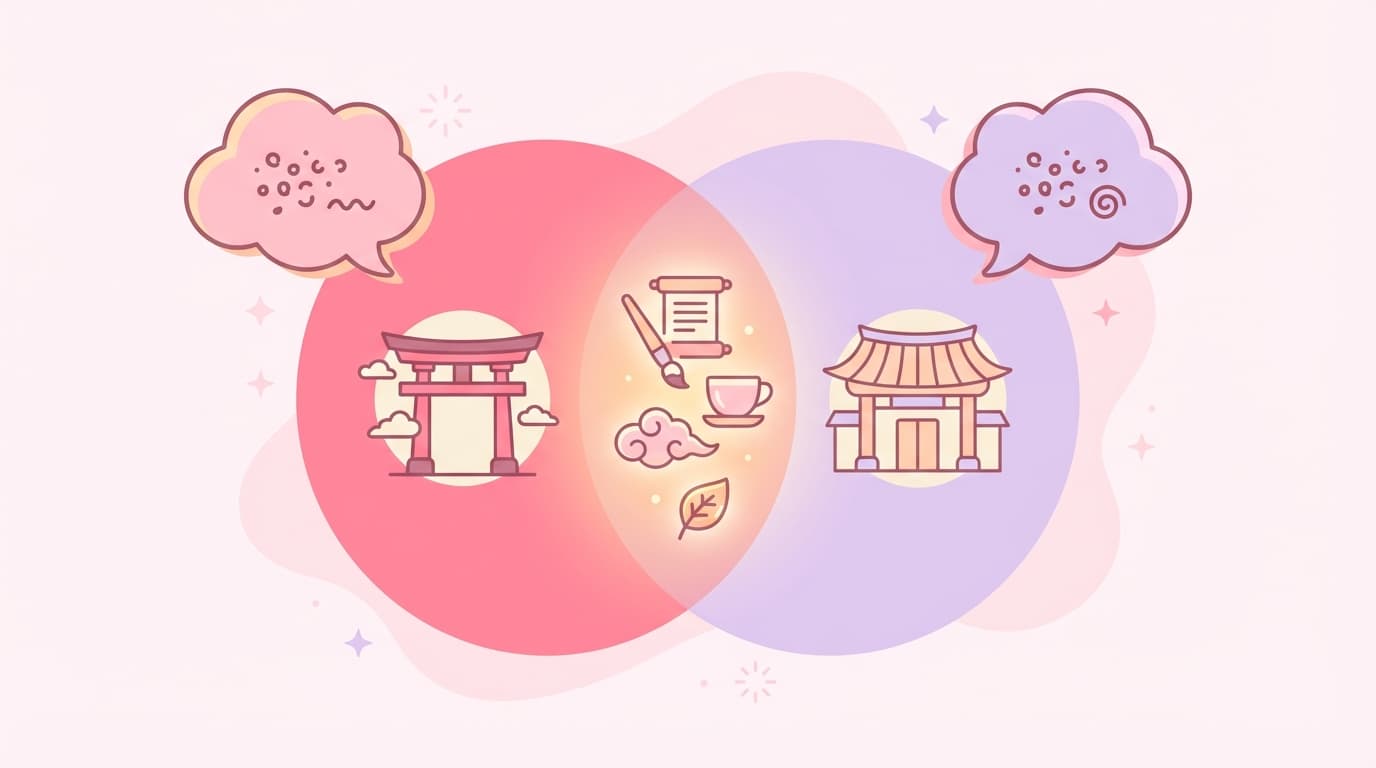
If you speak Korean and you're thinking about learning Japanese, you're in an extraordinary position. Language researchers consistently find that Korean speakers acquire Japanese faster than learners from almost any other language background. The structural similarities run so deep that what takes a typical English speaker two years to grasp, a Korean speaker can often reach in six to twelve months.
But "you'll learn fast" isn't a strategy. Knowing why Korean helps you — and where it won't — makes the difference between smooth progress and wasted effort. This guide gives you an honest roadmap: what to expect, how to study, and which Korean knowledge you can use directly versus which habits you'll need to break.
Quick Answer
Quick Answer: Korean speakers learn Japanese faster than almost any other group because the two languages share SOV sentence structure, a particle system, agglutinative grammar, and thousands of Chinese-origin vocabulary words. A dedicated Korean speaker can typically reach conversational level in 6–12 months and JLPT N3 within 12–18 months.
Why Korean Speakers Learn Japanese So Fast
The short answer is structure. Korean and Japanese are grammatically parallel in ways that no other major language pair matches.
1. Same sentence structure (SOV)
Both languages put the verb at the end of the sentence. In English, you say "I eat sushi." In both Korean and Japanese, the action comes last:
- Korean: 나는 스시를 먹는다 (Na-neun seusi-reul meongneunda)
- Japanese: 私はすしを食べる (Watashi wa sushi wo taberu)
The word order is identical: Subject + topic marker, Object + object marker, Verb. This transfers directly, with no mental restructuring required.
2. A matching particle system
Korean and Japanese both use particles — small grammatical markers attached after nouns to show their role in a sentence. The equivalents are remarkably close:
| Japanese Particle | Korean Equivalent | Function |
|---|---|---|
| は (wa) | 은/는 (eun/neun) | Topic marker |
| が (ga) | 이/가 (i/ga) | Subject marker |
| を (wo) | 을/를 (eul/reul) | Object marker |
| に/へ (ni/e) | 에/에게 (e/ege) | Direction, location |
| で (de) | 에서/으로 (eseo/euro) | Location of action, means |
| も (mo) | 도 (do) | Also, too |
The nuances differ in ways that will trip you up at intermediate level — but at the beginner stage, this parallel structure means Japanese sentences make intuitive sense from day one.
3. Hanja gives you thousands of free vocabulary words
Korean uses Hanja (한자) — Chinese-origin vocabulary — for roughly 60% of its formal and written vocabulary. Japanese uses the same characters with similar readings and meanings.
This means that many Korean words you already know have Japanese equivalents that are immediately recognizable:
- 학교 (hakgyo) → 学校 (gakkō) — school
- 시간 (sigan) → 時間 (jikan) — time
- 사회 (sahoe) → 社会 (shakai) — society
- 경제 (gyeongje) → 経済 (keizai) — economy
- 수업 (su-eop) → 授業 (jugyō) — lesson/class
These aren't exact matches, but they're close enough that a Korean speaker often recognizes the meaning of written Japanese words immediately, even before formally studying them.
4. Agglutinative grammar with verb endings
Both languages build meaning by attaching endings to verb stems. If you're already comfortable with Korean verb conjugation, the concept of Japanese verb forms — て-form, ます-form, ない-form — will feel natural. The mechanic is the same, even if the specific endings differ.
Where Korean Won't Help (And Where It Might Hurt)
Korean gives you an enormous head start, but some areas require fresh learning and extra attention.
Writing system: Start from zero
Japanese uses three scripts: hiragana, katakana, and kanji. Korean uses hangul, which doesn't carry over. You'll need to learn hiragana and katakana from scratch — though both can typically be memorized in one to two weeks of focused study.
The good news: once you learn kanji, your Korean Hanja knowledge dramatically speeds up recognition of meaning. A character you've seen in Korean context (even if you can't read the Japanese pronunciation) will feel familiar.
Pronunciation: Unlearn the habits
Korean has final consonants (받침 — batchim) that don't exist in Japanese. Japanese syllables are almost all open (consonant + vowel). Korean speakers sometimes add ghost consonants to Japanese words or drop mora (sound units). Pronunciation drilling is important for Korean learners specifically.
Japanese also has pitch accent — a tonal system that affects word meaning. Korean doesn't use this system. While pitch accent isn't critical for basic communication, it's worth being aware of, especially if you plan to reach N2–N1 level.
False friends in Hanja vocabulary
Some Hanja words look the same but mean different things in Korean and Japanese. For example:
- 勉強 (benkyō) means "study" in Japanese. In Korean, the same characters (면강) aren't commonly used with this meaning.
- 汽車 (kisha) means "steam train" in Japanese but 기차 (gicha) is just "train" in Korean.
Don't assume shared Hanja always means the same thing. Verify when in doubt.
Politeness levels: More complex in Japanese
Korean has a complex honorific system, which gives you a conceptual foundation. But Japanese keigo (敬語) adds layers — especially sonkeigo (respectful language) and kenjōgo (humble language) — that go beyond what Korean learners typically expect. This matters most at upper-intermediate and advanced levels.
Your 6-Month Roadmap (Korean Speaker Edition)
Here's a realistic progression that assumes 45–60 minutes of daily study:
Months 1–2: Foundations
- Learn hiragana (target: 1 week)
- Learn katakana (target: 1–2 weeks)
- Study basic vocabulary using your Hanja knowledge as a bridge
- Begin verb conjugation basics (ます-form, て-form)
- Target: JLPT N5 vocabulary and grammar
Your Korean grammar instinct will make N5 grammar feel almost too easy at this stage. Don't get complacent — the writing and pronunciation systems need dedicated time.
Months 3–4: N5 to N4
- Introduce kanji study (aim for 100–150 kanji)
- Expand verb forms (て-form usage, ない-form, potential form)
- Practice speaking and listening alongside reading
- Take a practice JLPT N5 test to verify your level
- Target: Ready for JLPT N5, beginning N4 content
If you want structured practice material for this phase, our JLPT N5 study guide covers the exact vocabulary and grammar needed for N5.
Months 5–6: N4 consolidation
- Study N4 grammar patterns (~100 essential patterns)
- Expand kanji to 200–300 characters
- Add regular listening practice — native-speed audio
- Consider registering for JLPT N5 or N4 depending on your comfort level
- Target: Conversational confidence in simple situations
At this point, most dedicated Korean learners have clear conversational ability in everyday situations — a level that would typically take a native English speaker 12–18 months or more.
Example Sentences: Korean Speakers' Advantage in Action
Notice how closely these Korean and Japanese sentences mirror each other:
| Japanese | Romaji | English |
|---|---|---|
| 私は学生です。 | Watashi wa gakusei desu. | I am a student. |
| 駅まで歩いて行きます。 | Eki made aruite ikimasu. | I'll walk to the station. |
| 日本語を勉強しています。 | Nihongo wo benkyō shite imasu. | I am studying Japanese. |
| 会議は何時に始まりますか? | Kaigi wa nanji ni hajimarimasu ka? | What time does the meeting start? |
| 先生に質問してもいいですか? | Sensei ni shitsumon shite mo ii desu ka? | May I ask the teacher a question? |
Korean speakers often recognize the grammatical logic of these sentences even before formally studying them — because the bones are the same.
Common Mistakes
1. Skipping hiragana practice because grammar feels easy Korean learners sometimes race through grammar topics because they click intuitively, but neglect writing system practice. Without solid hiragana and katakana, you'll hit a wall when real texts appear.
2. Pronouncing Japanese like Korean Korean pronunciation patterns — especially the tendency toward strong consonants and final consonant sounds — can carry into Japanese. Record yourself speaking and compare to native audio regularly.
3. Over-relying on Hanja guessing Hanja knowledge is genuinely useful, but guessing meaning from characters without confirming can lead to accumulated errors. Treat Hanja as a hint, not a translation.
4. Underestimating kanji volume JLPT N3 requires knowledge of approximately 650 kanji. Even with Hanja background, you still need to learn Japanese readings (on'yomi and kun'yomi) for each character, which takes dedicated study.
5. Ignoring listening from day one Some Korean learners focus almost entirely on reading and grammar, where their advantage is greatest. But listening comprehension requires its own daily practice. Start early.
Tips for Speakers of Other Languages
Learning Japanese can feel different depending on your native language. Here are specific tips for comparison:
For Korean speakers (한국어 화자) This article is specifically written for your advantage as a Korean speaker. The key additional insight: your structural advantage is most powerful at beginner level and gradually normalizes as you advance. At N1 level, the playing field is much more even — vocabulary breadth and reading speed matter more than grammatical intuition. Use the head start to build momentum, not to coast.
For Chinese speakers (中文母语者) Chinese speakers share a different but equally significant advantage with Korean speakers — kanji recognition. Where Korean speakers have grammar, Chinese speakers have characters. The combination of shared vocabulary meaning (Chinese) and shared grammar intuition (Korean) is the reason both groups learn Japanese faster than European learners, though through different strengths.
For Vietnamese speakers (Người nói tiếng Việt) Vietnamese doesn't share Japanese grammar structure or kanji in the way Korean and Chinese do. However, some formal Sino-Vietnamese vocabulary (borrowed from classical Chinese) overlaps with Japanese on'yomi terms. Vietnamese speakers should plan for a longer initial foundation phase — typically 6–9 months to reach the grammar intuition level a Korean speaker achieves in 2–3 months.
For Spanish speakers (Hablantes de español) Spanish speakers are starting from a completely different structural background — SVO vs. SOV, no particles, different phonology. The key advantage for Spanish speakers is that Spanish has complex verb conjugation (six forms per tense), which means the concept of grammatical morphology isn't entirely new. Approach Japanese as a different type of complex grammar, not as a simpler system.
For Indonesian speakers (Penutur bahasa Indonesia) Indonesian has simpler grammar than Japanese in many respects — no verb conjugation for tense, no particles. For Indonesian speakers, the transition to Japanese grammar complexity requires accepting that "things that are implied in Indonesian need explicit markers in Japanese." Building the habit of always adding the right particle or verb ending takes deliberate practice.
Practice Tips
-
Use your Hanja to anchor new kanji — When you encounter a new kanji, check if you recognize it from Korean Hanja. If so, use that connection as a memory hook. This dramatically speeds up kanji retention.
-
Practice sentences, not isolated words — Because your grammar instinct is already calibrated for Japanese-like structures, you'll learn most efficiently by working with whole sentences rather than vocabulary lists.
-
Listen to native Japanese audio at your level — Korean learners sometimes fall behind on listening because grammar clicks so fast. Use content matched to your current level daily.
-
Take JLPT N5 early — Given your structural advantage, consider taking JLPT N5 after just 3–4 months. An early pass builds confidence and confirms your foundation is solid before moving to N4.
-
Work on pronunciation deliberately — This is the one area where Korean knowledge can actively interfere. Dedicate 10 minutes per day specifically to pronunciation practice, especially vowel length and pitch.
Real Learner Insights
Based on common patterns we see among Japanese learners:
- The "aha" moment: Many Korean learners describe a very early breakthrough — within the first few weeks — when they realize they can understand the basic logic of Japanese sentences almost intuitively. Sentences like 駅まで歩いて行きます click without translation because the bones are already familiar. This early success is motivating, but the lasting breakthrough comes later when the vocabulary depth catches up to the grammatical intuition.
- Common confusion point: Korean learners are consistently surprised by how different Japanese politeness levels (keigo) are from Korean honorifics. Korean has a sophisticated honorific system, so learners expect Japanese keigo to feel familiar — but the specific vocabulary and grammar forms (sonkeigo, kenjōgo) are entirely different and require fresh memorization, often more so than other grammar areas.
- What works: Korean learners tend to progress fastest when they deliberately balance their grammar strength with equal investment in vocabulary and listening. The learners who plateau are usually those who race ahead on grammar (where it's easy) but neglect building the vocabulary base. Steady vocabulary growth — even just 10 words per day — compounds dramatically over a year.
Frequently Asked Questions
Q: How long does it take a Korean speaker to learn Japanese? Most dedicated Korean learners (45–60 min/day) reach conversational ability in 6–12 months and JLPT N3 in 12–18 months. English speakers typically need 2–3 years to reach the same point.
Q: Should I use Korean or English materials to study Japanese? Korean-language Japanese study materials exist and are widely used in Korea — and they often account for the Korean speaker's starting point explicitly. English materials work fine too. Choose based on which you find clearer, not based on language prestige.
Q: Do I need to learn hiragana before anything else? Yes. Hiragana is the foundation of written Japanese. Every grammar resource, every vocabulary entry, and every kanji reading uses hiragana. Target learning it in one week before starting anything else.
Q: Is Japanese grammar really that similar to Korean grammar? At the sentence structure level, yes — more similar than any other major language pair. Particles, verb endings, sentence order, and the absence of articles all parallel Korean. The vocabulary pronunciation systems diverge significantly, but grammar intuition carries over directly.
Q: What JLPT level should I target first? Most Korean speakers with basic study preparation are ready for JLPT N5 within 3–4 months. If you've already studied some Japanese informally, N4 may be your starting point. There's no requirement to take the levels in order.
Q: How does the Korean speaker advantage compare to the Chinese speaker advantage for learning Japanese? Both groups have significant advantages, but through different strengths. Korean speakers have grammar — sentence structure, particles, and verb-ending patterns transfer almost directly. Chinese speakers have characters — they can read and understand written Japanese at a surprisingly high level early on. Korean speakers typically excel faster in speaking and grammar production; Chinese speakers typically excel faster in reading and vocabulary recognition.
Q: Do Korean speakers have trouble with Japanese pronunciation specifically? Yes, this is the most documented difficulty for Korean learners. Korean has batchim (final consonant sounds) that don't exist in Japanese, and Japanese has vowel length distinctions and pitch accent that Korean doesn't use the same way. Korean speakers occasionally "add" ghost consonants to Japanese syllables or mispronounce long vowels. Dedicated pronunciation drilling — especially shadowing native audio — is more important for Korean learners than for most other language backgrounds.
Q: At what JLPT level does the Korean structural advantage stop making a difference? By N2, the advantage has largely been absorbed into the learner's overall Japanese ability. At N1, vocabulary breadth, reading speed in native materials, and abstract comprehension are the differentiating factors — areas where native language background matters much less than total study time and exposure to Japanese.
Related Resources
- Watch JLPT N5 lessons on YouTube
- JLPT N5 Study Materials — PDF Download
- JLPT N4 Study Materials — PDF Download