Introduction
Thinking about taking the JLPT N5? It's the very first step on your Japanese language journey, and passing it proves you've built a solid foundation. The N5 tests your ability to understand basic Japanese — reading simple sentences, catching everyday phrases in conversation, and recognizing fundamental kanji.
The good news is that N5 is the most approachable level of the JLPT. With a focused study plan and consistent practice, most learners can prepare for it in 3 to 6 months. This guide breaks down exactly what you need to know and how to study for it.
What Does the JLPT N5 Test?
The N5 exam is divided into two main sections:
Section 1: Language Knowledge + Reading (50 minutes)
- Vocabulary: Kanji readings, word definitions, contextual word usage
- Grammar: Choosing the correct grammar form, sentence ordering, passage-based grammar
- Reading: Short passages (100-200 characters) with comprehension questions
Section 2: Listening (30 minutes)
- Task-based: Listen and choose the correct response to a specific situation
- Key phrase comprehension: Identify the main point of a short conversation
- Quick response: Choose the best reply to a spoken question
The total score is 180 points (120 for Language Knowledge + Reading, 60 for Listening). You need at least 80 points overall, with a minimum of 38 in Language Knowledge + Reading and 19 in Listening.
JLPT N5 Study Guide: Mastering Hiragana and Katakana
Before you even think about vocabulary or grammar, you need to master hiragana and katakana. These two writing systems are the absolute foundation of Japanese.
Hiragana (ひらがな) — 46 basic characters used for native Japanese words, grammatical particles, and verb conjugations.
Katakana (カタカナ) — 46 basic characters primarily used for foreign loanwords, onomatopoeia, and emphasis.
Here's how to learn them efficiently:
Week 1-2: Hiragana
Start by learning 5-10 characters per day. Use mnemonic associations — for example, あ (a) looks like someone saying "Ahh!" Don't just recognize them; practice writing each one by hand. Writing helps your brain form stronger connections.
Week 3-4: Katakana
Many learners find katakana harder because the characters look more angular and similar to each other. Use the same approach — mnemonics and handwriting practice — but also start reading katakana in the wild. Menu items, product names, and signs in Japan are full of katakana.
Ongoing Practice
Read everything you can in hiragana and katakana. Children's books, NHK Easy News, and even Japanese social media are great sources of practice material.
The 103 N5 Kanji You Need to Know
N5 requires approximately 103 kanji characters. These are the most basic and frequently used kanji in daily life. Here are the major categories:
Numbers (数字)
| Kanji | Reading | Meaning |
|---|---|---|
| 一 | いち (ichi) | one |
| 二 | に (ni) | two |
| 三 | さん (san) | three |
| 四 | し/よん (shi/yon) | four |
| 五 | ご (go) | five |
| 六 | ろく (roku) | six |
| 七 | しち/なな (shichi/nana) | seven |
| 八 | はち (hachi) | eight |
| 九 | きゅう/く (kyuu/ku) | nine |
| 十 | じゅう (juu) | ten |
| 百 | ひゃく (hyaku) | hundred |
| 千 | せん (sen) | thousand |
| 万 | まん (man) | ten thousand |
Time and Calendar (時間・暦)
| Kanji | Reading | Meaning |
|---|---|---|
| 日 | にち/ひ (nichi/hi) | day / sun |
| 月 | げつ/つき (getsu/tsuki) | month / moon |
| 年 | ねん/とし (nen/toshi) | year |
| 時 | じ/とき (ji/toki) | time / hour |
| 分 | ふん/ぶん (fun/bun) | minute / part |
| 半 | はん (han) | half |
| 今 | いま (ima) | now |
| 先 | せん/さき (sen/saki) | previous / ahead |
| 前 | まえ (mae) | before / front |
| 後 | あと/ご (ato/go) | after / behind |
People and Body (人・体)
| Kanji | Reading | Meaning |
|---|---|---|
| 人 | ひと/じん (hito/jin) | person |
| 子 | こ (ko) | child |
| 女 | おんな (onna) | woman |
| 男 | おとこ (otoko) | man |
| 目 | め (me) | eye |
| 耳 | みみ (mimi) | ear |
| 口 | くち (kuchi) | mouth |
| 手 | て (te) | hand |
| 足 | あし (ashi) | foot / leg |
Tips for Kanji Study
- Learn readings in context — Don't just memorize isolated readings. Learn kanji through vocabulary words. For example, learn 日曜日 (にちようび, Sunday) rather than memorizing all the readings of 日 separately.
- Use spaced repetition — Apps like Anki or WaniKani help you review kanji right before you're about to forget them.
- Write by hand — Even if you mainly type in Japanese, handwriting reinforces stroke order and visual memory.
If you want a structured approach to N5 kanji and vocabulary, check out the JLPT N5 Complete Guide Book for organized lessons with practice exercises.
Building Your N5 Vocabulary (800 Words)
The JLPT N5 requires about 800 vocabulary words. That might sound like a lot, but many of them are everyday words you'll encounter constantly in Japanese. Here's how to approach it:
Core Categories to Focus On
- Greetings and daily expressions: おはようございます, すみません, ありがとう
- Family terms: お父さん, お母さん, 兄, 姉, 弟, 妹
- Food and drink: ごはん, パン, 水, お茶, 肉, 魚
- Places: 学校, 駅, 病院, 銀行, 郵便局
- Adjectives: 大きい, 小さい, 新しい, 古い, 高い, 安い
- Verbs: 食べる, 飲む, 行く, 来る, 見る, 聞く, 読む, 書く
Study Method: 15-20 Words Per Day
If you learn 15-20 new words daily and review previously learned words, you can cover 800 words in about two months. Here's a daily routine that works:
- Morning (15 min): Learn 15-20 new words with example sentences
- Lunch break (10 min): Review flashcards from the past week
- Evening (15 min): Review all words from today and quiz yourself
Example Vocabulary with Sentences
| Japanese | Romaji | English |
|---|---|---|
| 毎日 日本語を 勉強します。 | Mainichi nihongo wo benkyou shimasu. | I study Japanese every day. |
| 駅は どこですか。 | Eki wa doko desu ka. | Where is the station? |
| この りんごは 大きいです。 | Kono ringo wa ookii desu. | This apple is big. |
| 明日 友達と 映画を 見ます。 | Ashita tomodachi to eiga wo mimasu. | I'll watch a movie with a friend tomorrow. |
| 朝ごはんを 食べませんでした。 | Asagohan wo tabemasen deshita. | I didn't eat breakfast. |
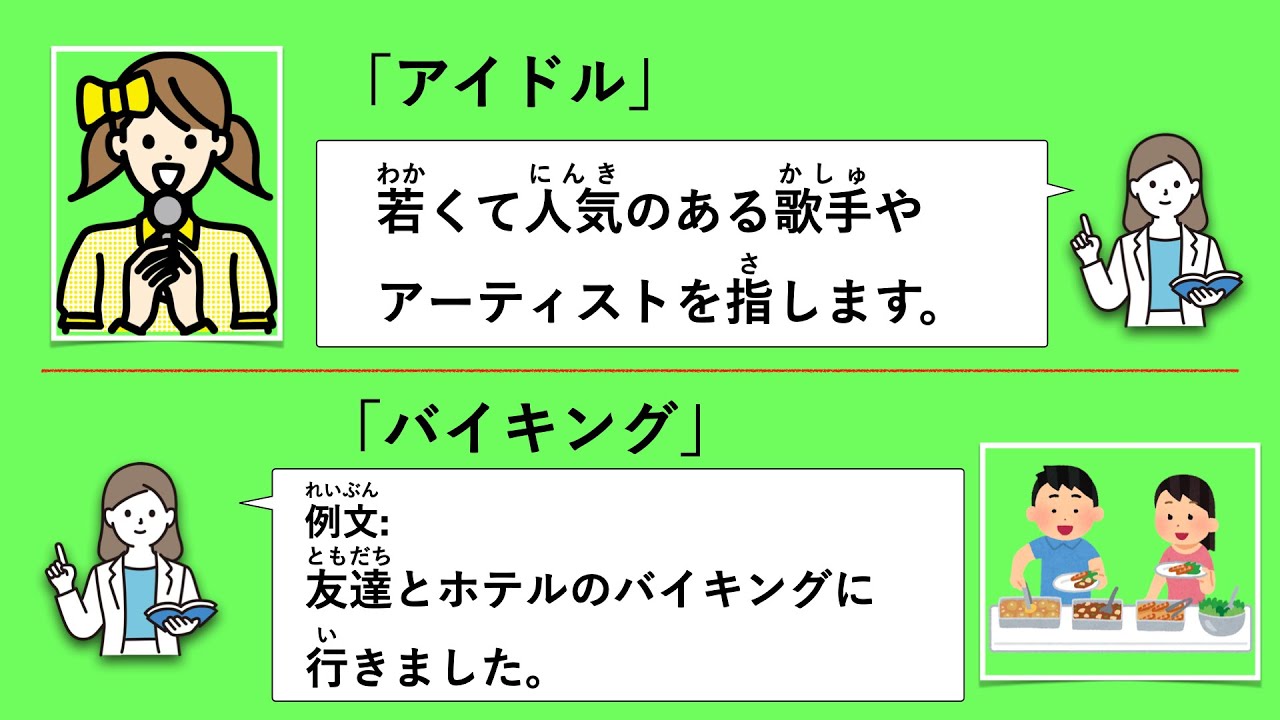
Listening to Rico-sensei's YouTube lessons is also a great way to hear N5 vocabulary used in natural contexts. Try watching the katakana vocabulary lesson to boost your katakana word bank while building listening skills.
Essential N5 Grammar Patterns
N5 grammar covers the fundamental building blocks of Japanese sentences. Here are the most important patterns organized by function:
Basic Sentence Structure: ~です / ~ます
The polite copula です and the polite verb ending ~ます are the backbone of polite Japanese. Almost every N5 sentence uses one of these.
- これは 本です。(Kore wa hon desu.) — This is a book.
- 毎日 走ります。(Mainichi hashirimasu.) — I run every day.
Particles: は, が, を, に, で, へ, の, も, と, から, まで
Particles are the glue of Japanese grammar. N5 tests your ability to choose the correct particle for each context.
| Particle | Function | Example |
|---|---|---|
| は (wa) | Topic marker | 私は 学生です。(I am a student.) |
| が (ga) | Subject marker | 猫が います。(There is a cat.) |
| を (wo) | Object marker | 水を 飲みます。(I drink water.) |
| に (ni) | Time / location / direction | 7時に 起きます。(I wake up at 7.) |
| で (de) | Location of action / means | 学校で 勉強します。(I study at school.) |
| へ (e) | Direction | 日本へ 行きます。(I go to Japan.) |
| の (no) | Possession / connection | 私の 本。(My book.) |
Verb Conjugation Basics
N5 requires you to know these verb forms:
- ます form (polite present/future): 食べます
- ません form (polite negative): 食べません
- ました form (polite past): 食べました
- ませんでした form (polite past negative): 食べませんでした
- て form (connecting / requests): 食べて
For a deeper look at how Japanese grammar works in conversation, the JLPT General Tips guide covers strategies that apply across all levels.
Question Words
| Japanese | Romaji | English |
|---|---|---|
| 何 (なに/なん) | nani/nan | what |
| 誰 (だれ) | dare | who |
| どこ | doko | where |
| いつ | itsu | when |
| どう | dou | how |
| なぜ/どうして | naze/doushite | why |
| いくら | ikura | how much |
| いくつ | ikutsu | how many |
Adjective Patterns
N5 covers both i-adjectives (大きい, 小さい, 高い) and na-adjectives (きれいな, 静かな, 有名な). You need to know how to use them in present, past, negative, and connecting forms.
| Form | i-adjective (高い) | na-adjective (静かな) |
|---|---|---|
| Present | 高いです | 静かです |
| Negative | 高くないです | 静かじゃないです |
| Past | 高かったです | 静かでした |
| Past negative | 高くなかったです | 静かじゃなかったです |
What the N5 Test Questions Actually Look Like
Understanding the test format helps you prepare more effectively. Here's what to expect in each section:
Vocabulary Questions
Type 1: Kanji Reading — Choose the correct reading for the underlined kanji.
今日は 天気 がいいです。 a) でんき b) てんき c) げんき d) てんさい
Type 2: Word Meaning — Choose the word that fits the blank.
つくえの うえに ほんが ___ あります。 a) ひとつ b) いちまい c) いっさつ d) いっぽん
Grammar Questions
Type: Sentence Completion — Choose the correct particle or grammar form.
きのう ともだち__えいがを みました。 a) を b) に c) と d) で
Reading Questions
Short passages of 100-200 characters about everyday topics — a notice board, a simple email, a schedule. You'll answer 1-2 questions per passage.
Listening Questions
You'll hear short conversations and need to choose the correct answer from picture options or written choices. The conversations use simple, everyday Japanese at a natural but clear pace.
Common Mistakes N5 Learners Make
Knowing what trips up other learners can help you avoid the same pitfalls:
1. Confusing は (wa) and が (ga)
This is probably the most common mistake for beginners. As a simple rule: は marks the topic (what you're talking about) and が marks the subject (what does the action or has the quality, especially with new information).
- 私は 学生です。(Speaking about myself: I'm a student.)
- 誰が 来ましたか。(Who came? — asking about new information)
2. Mixing up て form and た form
て connects to the next action or makes requests. た makes past tense. They're made the same way but used differently.
- 食べてください。(Please eat. — request)
- 食べた。(I ate. — past tense)
3. Forgetting counters
Japanese uses different counters for different types of objects. N5 covers the most common ones:
| Counter | Used for | Example |
|---|---|---|
| ~つ | General objects | みっつ (3 things) |
| ~人 | People | 三人 (3 people) |
| ~枚 | Flat objects | 二枚 (2 sheets) |
| ~本 | Long objects | 一本 (1 bottle/pen) |
| ~杯 | Cups/glasses | 二杯 (2 cups) |
| ~匹 | Small animals | 三匹 (3 small animals) |
4. Overusing 私は (watashi wa)
In Japanese, the subject is often dropped when it's obvious from context. Saying 私は at the start of every sentence sounds unnatural. Once you've established that you're talking about yourself, drop it.
Tips for Speakers of Other Languages
Learning JLPT N5 can feel different depending on your native language. Here are specific tips:
For Korean speakers (한국어 화자) The SOV sentence structure and particle system of Japanese map almost directly onto Korean. When you study N5 particles like は, が, and を, you'll immediately recognize the parallel to 은/는, 이/가, and 을/를. Use this as scaffolding — but pay close attention to the subtle differences in nuance, as they start to diverge at intermediate level.
For Chinese speakers (中文母语者) Your character knowledge dramatically accelerates vocabulary recognition. Focus your N5 study energy on readings (furigana) and the kana systems rather than kanji meanings, which you likely already know. Beware of false friends: 走る (hashiru) means "to run" in Japanese but "to walk" in Chinese — opposite meanings can cause real confusion.
For Vietnamese speakers (Người nói tiếng Việt) Vietnamese uses SVO word order (like English), so putting the verb at the end of Japanese sentences requires deliberate practice. One helpful approach: practice translating short Vietnamese sentences into Japanese, consciously moving the verb to the end each time. Your experience with tonal distinctions in Vietnamese can help you stay attuned to pitch differences in Japanese audio.
For Spanish speakers (Hablantes de español) The open syllable structure of Japanese (consonant + vowel) matches Spanish closely, making hiragana pronunciation very natural. The challenge is the particle system — Spanish has no equivalent, so particles like に and で require building intuition through extensive practice rather than translation rules.
For Indonesian speakers (Penutur bahasa Indonesia) Indonesian and Japanese share a relatively flexible word order in casual speech and both drop subjects frequently in context. The concept of sentence-final particles (like ね and よ) for softening or emphasizing statements may feel somewhat familiar if you've noticed similar pragmatic markers in Indonesian conversation.
Practice Tips for Passing N5
1. Take Mock Tests Regularly
The official JLPT website offers sample questions. Use them. Time yourself strictly — 50 minutes for Section 1 and 30 minutes for Section 2. Getting comfortable with the time pressure is half the battle.
2. Immerse Yourself Daily
Even 15-20 minutes of daily Japanese exposure makes a huge difference. Watch Rico-sensei's N5-level YouTube lessons where everyday topics are explained in simple, natural Japanese. The daily routine lesson is particularly helpful for hearing common N5 vocabulary and grammar in action.
3. Study with a Partner
If you can find a study partner, practice simple conversations together. Even basic exchanges like asking directions, talking about your daily schedule, or ordering food at a restaurant will reinforce what you've learned.
4. Focus on Your Weak Points
After each mock test, identify which section gave you the most trouble. If it's listening, spend extra time on audio practice. If it's reading, work on your kanji recognition speed. Don't waste time reviewing what you already know well.
5. Use the Last Month for Review Only
In the final month before the test, stop learning new material. Focus entirely on reviewing what you've already studied and taking full practice tests. This consolidation period is crucial for retention.
Real Learner Insights
Based on common patterns we see among Japanese learners:
- The "aha" moment: A turning point many N5 learners describe is when the counters finally click. Learning that 一本, 一枚, and 一つ all mean "one" but apply to different objects feels baffling at first — then one day, you reach for the right counter without thinking, and you realize the pattern is now automatic.
- Common confusion point: The te-form is where many learners stall at N5. The same ending (-て or -で) applies to verbs, but which verbs get which ending isn't obvious from the dictionary form. Many learners find that practicing one verb group at a time — all Group 1 verbs first, then Group 2 — is more effective than trying to memorize them all at once.
- What works: Watching the same short Japanese video clip multiple times — once with subtitles, once without, then trying to transcribe key phrases — builds both listening comprehension and vocabulary retention far faster than passive listening alone.
Your N5 Study Timeline
Here's a suggested 4-month plan for N5 preparation:
| Month | Focus | Daily Time |
|---|---|---|
| Month 1 | Hiragana, katakana, basic greetings, numbers | 30-45 min |
| Month 2 | Core vocabulary (400 words), basic particles, です/ます | 45-60 min |
| Month 3 | Remaining vocabulary, all N5 grammar, kanji (50 kanji) | 60 min |
| Month 4 | Remaining kanji, mock tests, review weak areas | 60-90 min |
This is a comfortable pace. If you're already familiar with hiragana and katakana, you can compress this to 2-3 months by starting from Month 2.
What Comes After N5
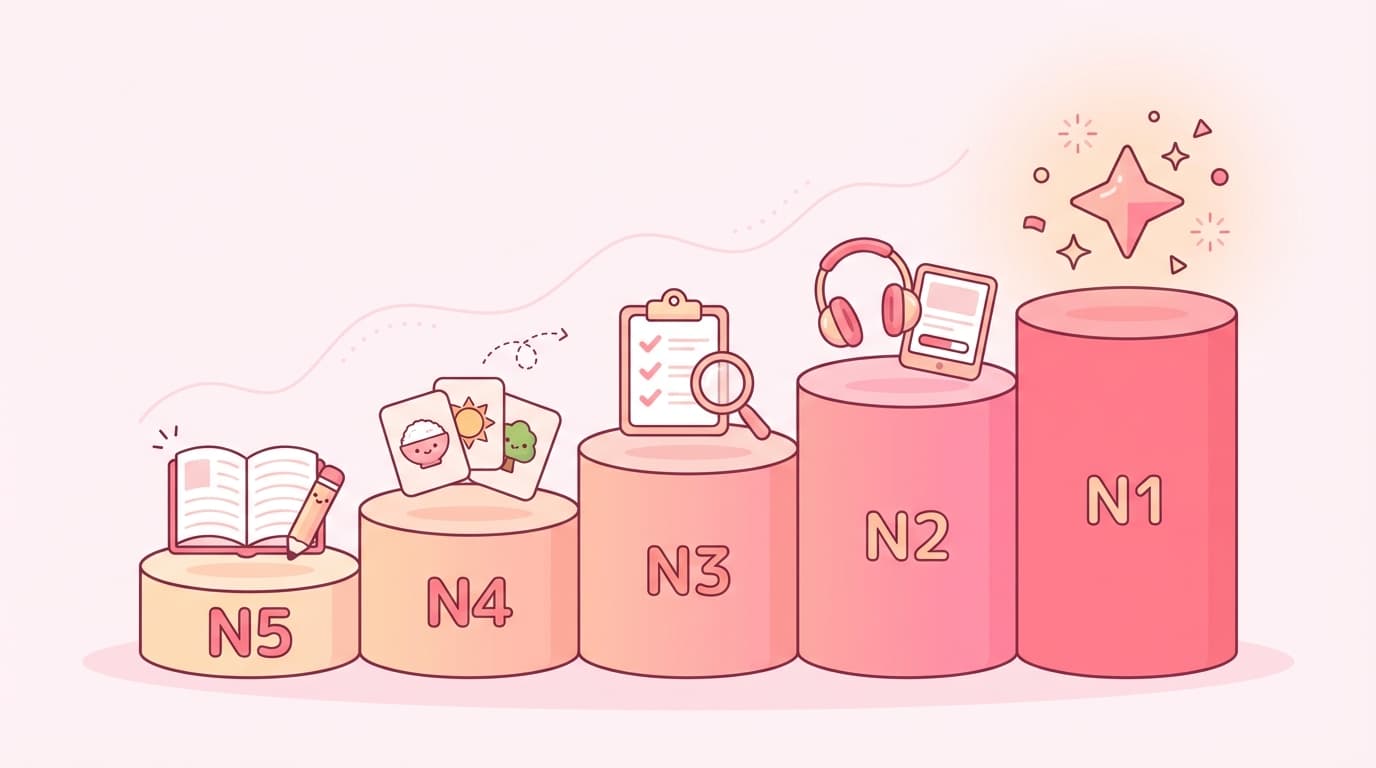
Once you pass N5, you'll have a solid foundation to build on. The natural next step is N4, which roughly doubles the vocabulary and kanji requirements. Many learners find the jump from N5 to N4 manageable because the grammar structures expand logically from what you already know.
Beyond that, N3 is the true intermediate milestone — it's where you start reading and understanding real Japanese content. And if you're serious about long-term Japanese study, check out our study methods guide for strategies that will serve you from N5 all the way to N1.
For structured study material that matches the N5 curriculum, the JLPT N5 Complete Guide Book covers all 103 kanji, 800 vocabulary words, and grammar patterns with practice exercises and mini-tests.
Q: Do Korean speakers have a real advantage on JLPT N5? Yes — a substantial one. Korean grammar and Japanese grammar are structurally parallel, so concepts like SOV sentence order, particles, and verb-ending conjugations transfer directly. Korean speakers typically need half the time to reach N5 readiness compared to English speakers. The one caveat: writing systems are completely different, so hiragana and katakana still require the same dedicated study for everyone.
Q: How should Chinese speakers approach N5 vocabulary study differently? Chinese speakers can safely de-prioritize learning kanji meanings (which they largely know) and instead focus their vocabulary time on readings. A practical approach: when making flashcards, put the kana reading on the front and the kanji + meaning on the back. This reorients study toward the area that genuinely needs work — pronunciation — while still reinforcing meaning.
Q: Is the JLPT N5 listening section harder for non-Asian language speakers? The listening section tests comprehension of natural-paced Japanese, which is unfamiliar to all beginners regardless of background. However, speakers of Korean and Chinese tend to adapt faster because they've already encountered Japanese vocabulary in their own languages. European language speakers often need 4–6 extra weeks of active listening practice to feel comfortable with the N5 listening section.
Related Resources
- JLPT Study Tips for All Levels — Overview of all JLPT levels and general strategies
- JLPT N3 Reading Comprehension Guide — For when you're ready to level up
- Japanese Study Methods — Effective study techniques for all learners
- JLPT N5 Complete Guide Book — Structured study material for N5
- Rico-sensei's YouTube Lessons — Video lessons for all JLPT levels