Introduction
You're sitting in a Japanese restaurant, staring at a menu full of kanji you can't read. The waiter's waiting. Your friends are waiting. And you're thinking about just pointing at a picture and hoping for the best.
Sound familiar? You're not alone. Ordering food is one of the first real-world tests for Japanese learners, and it can feel overwhelming. But here's the good news — you don't need to be fluent. A handful of key words and phrases will get you through almost any meal in Japan.
Quick Answer
Quick Answer: Learn these three phrases and you're set for most restaurants: すみません (sumimasen — "excuse me" to call staff), これをお願いします (kore wo onegai shimasu — "this one, please"), and お会計お願いします (okaikei onegai shimasu — "check, please"). Combine these with basic food vocabulary, and you'll eat well anywhere in Japan.
Essential Food Categories
Let's start with the main food categories you'll see on Japanese menus.
Rice and Noodles (主食 — shushoku):
| Japanese | Romaji | English |
|---|---|---|
| ごはん | gohan | rice (cooked) |
| お米 | okome | rice (uncooked) |
| うどん | udon | thick wheat noodles |
| そば | soba | buckwheat noodles |
| ラーメン | raamen | ramen |
| パン | pan | bread |
Meat and Fish (肉・魚 — niku / sakana):
| Japanese | Romaji | English |
|---|---|---|
| 牛肉 | gyuuniku | beef |
| 豚肉 | butaniku | pork |
| 鶏肉 | toriniku | chicken |
| 魚 | sakana | fish |
| エビ | ebi | shrimp |
| 刺身 | sashimi | raw fish slices |
Vegetables (野菜 — yasai):
| Japanese | Romaji | English |
|---|---|---|
| 野菜 | yasai | vegetables |
| 玉ねぎ | tamanegi | onion |
| にんじん | ninjin | carrot |
| キャベツ | kyabetsu | cabbage |
| きのこ | kinoko | mushroom |
| 豆腐 | toufu | tofu |
Popular Japanese Dishes
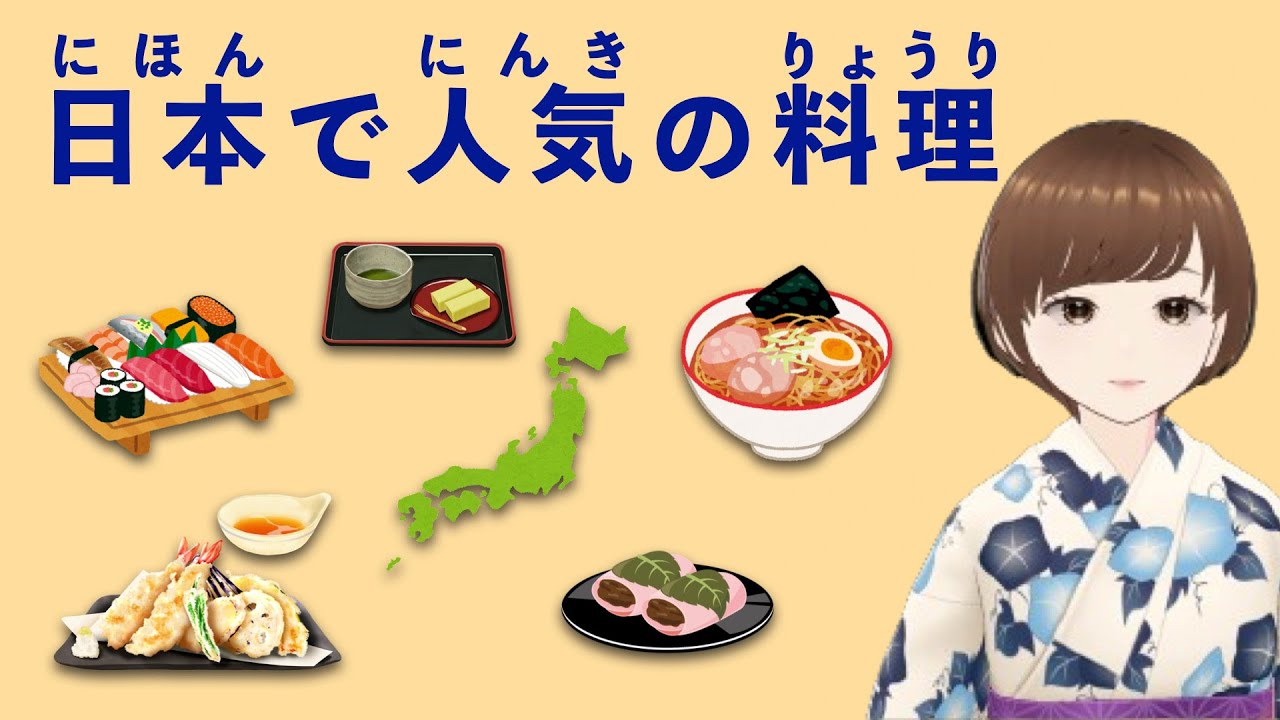
When you see these on a menu, you'll know exactly what you're getting:
| Japanese | Romaji | What It Is |
|---|---|---|
| 寿司 | sushi | vinegared rice with toppings |
| 天ぷら | tenpura | deep-fried battered food |
| カレーライス | karee raisu | Japanese curry with rice |
| 丼 | donburi | rice bowl with toppings |
| 焼き鳥 | yakitori | grilled chicken skewers |
| お好み焼き | okonomiyaki | savory pancake |
| 味噌汁 | misoshiru | miso soup |
| 定食 | teishoku | set meal |
The word 定食 (teishoku) is especially useful — it means a set meal that usually includes a main dish, rice, miso soup, and pickles. It's a great deal and takes the guesswork out of ordering.
Drinks (飲み物 — nomimono)
| Japanese | Romaji | English |
|---|---|---|
| 水 | mizu | water |
| お茶 | ocha | green tea |
| ビール | biiru | beer |
| 日本酒 | nihonshu | sake |
| コーヒー | koohii | coffee |
| ジュース | juusu | juice |
In most restaurants, water and tea are free. You don't need to order them — they'll be brought automatically. For more natural café conversations, check out our YouTube lesson on café culture.
Key Ordering Phrases
These phrases will get you through 90% of restaurant situations:
Getting attention:
- すみません。(Sumimasen.) — Excuse me. (to call the waiter)
Ordering:
- これをお願いします。(Kore wo onegai shimasu.) — This one, please. (pointing at menu)
- 〇〇をください。(〇〇 wo kudasai.) — I'd like 〇〇, please.
- 〇〇を二つお願いします。(〇〇 wo futatsu onegai shimasu.) — Two of 〇〇, please.
Asking questions:
- おすすめは何ですか?(Osusume wa nan desu ka?) — What do you recommend?
- これは何ですか?(Kore wa nan desu ka?) — What is this?
- 〇〇はありますか?(〇〇 wa arimasu ka?) — Do you have 〇〇?
Dietary needs:
- 肉なしでお願いします。(Niku nashi de onegai shimasu.) — Without meat, please.
- アレルギーがあります。(Arerugii ga arimasu.) — I have allergies.
Finishing up:
- お会計お願いします。(Okaikei onegai shimasu.) — Check, please.
- ごちそうさまでした。(Gochisousama deshita.) — Thank you for the meal. (said when leaving)
Reading a Japanese Menu
Japanese menus can look intimidating, but they follow patterns. Here are common words you'll spot:
| Japanese | Romaji | Meaning |
|---|---|---|
| 〇〇セット | 〇〇 setto | 〇〇 set (combo meal) |
| 大盛り | oomori | large serving |
| 小盛り | komori | small serving |
| 辛い | karai | spicy |
| 甘い | amai | sweet |
| 焼き | yaki | grilled |
| 揚げ | age | deep-fried |
| 煮 | ni | simmered |
| 生 | nama | raw / draft (beer) |
Look for 写真付き (shashin tsuki — "with photos") menus, or ask: 写真付きのメニューはありますか?(Shashin tsuki no menyuu wa arimasu ka?) — "Do you have a menu with pictures?"
Restaurant Etiquette
Japanese restaurants have a few customs you should know:
-
Say いただきます (itadakimasu) before eating — It means "I humbly receive this food." Everyone says it.
-
Don't tip — Tipping isn't customary in Japan. It can even be seen as rude.
-
Use the おしぼり (oshibori) — The wet towel you receive is for your hands only, not your face.
-
Chopstick rules — Don't stick chopsticks upright in rice (it resembles a funeral ritual). Don't pass food chopstick-to-chopstick.
-
Say ごちそうさまでした (gochisousama deshita) when leaving — It shows gratitude to the staff and chef.
-
Pay at the register — In many Japanese restaurants, you pay at the front counter, not at the table.
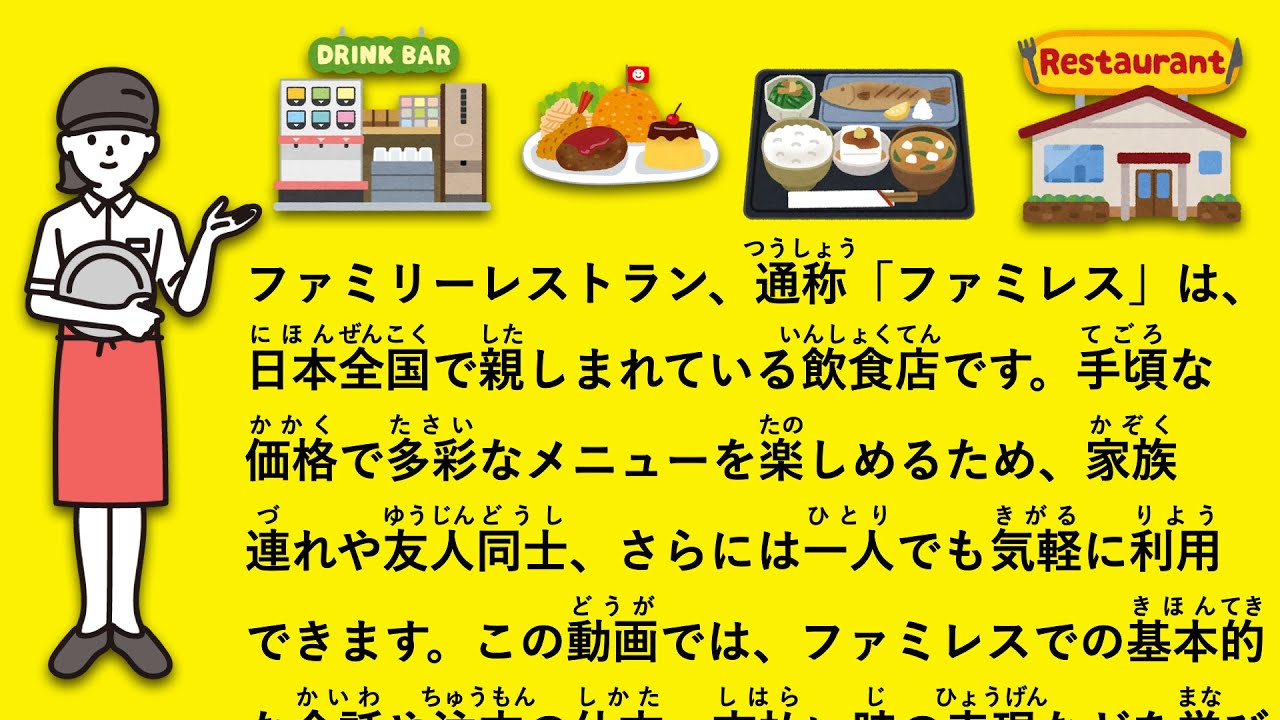
If you want to hear these phrases in context, our YouTube lesson on family restaurants walks through a complete dining experience.
Example Sentences
| Japanese | Romaji | English |
|---|---|---|
| すみません、メニューをください。 | Sumimasen, menyuu wo kudasai. | Excuse me, could I have a menu? |
| ラーメンを一つお願いします。 | Raamen wo hitotsu onegai shimasu. | One ramen, please. |
| おすすめは何ですか? | Osusume wa nan desu ka? | What do you recommend? |
| これは辛いですか? | Kore wa karai desu ka? | Is this spicy? |
| お水をもう一杯ください。 | Omizu wo mou ippai kudasai. | One more glass of water, please. |
| お会計お願いします。 | Okaikei onegai shimasu. | Check, please. |
| ごちそうさまでした。 | Gochisousama deshita. | Thank you for the meal. |
| 卵アレルギーがあります。 | Tamago arerugii ga arimasu. | I have an egg allergy. |
Common Mistakes
-
Forgetting to say すみません first — In Japan, you call the waiter yourself. They won't check on you repeatedly like in Western restaurants. Raise your hand and say すみません.
-
Saying ください for everything — ください is fine, but お願いします sounds more natural and polite in restaurants.
-
Mixing up 辛い (karai, spicy) and 甘い (amai, sweet) — These are easy to confuse for beginners. Remember: 辛 has the radical for "bitter/hard."
-
Not saying いただきます or ごちそうさまでした — Skipping these is like leaving without saying thank you. It's noticed.
-
Trying to tip — Don't do it. If you leave money on the table, the staff may chase you down to return it.
Tips for Speakers of Other Languages
Learning food vocabulary and restaurant ordering in Japanese can feel different depending on your native language. Here are specific tips:
For Korean speakers (한국어 화자) Korean food culture and Japanese food culture overlap significantly — both feature rice, fermented dishes, and similar dining customs. The biggest vocabulary advantage: many food names shared between Korean and Japanese have similar pronunciations due to shared Chinese roots (料理/요리, 食堂/식당). However, note that Japanese restaurants are generally quieter than Korean restaurants — the custom of vigorous conversation during meals is less common in Japan. Spend extra time on counter words for ordering: ひとつ, ふたつ for quantities and 一杯 (ippai) for drinks.
For Chinese speakers (中文母语者) You'll recognize many kanji on Japanese menus immediately: 牛肉, 豚肉, 野菜, 豆腐 are written identically or nearly identically in Chinese and Japanese. However, watch for menu false friends: 定食 (teishoku) in Japanese means "set meal," not just "fixed food." Also, Japanese お茶 is green tea served free, while in Chinese restaurants tea culture and charges vary. Use your kanji advantage to decode menus, but verify specific dish names before ordering.
For Vietnamese speakers (Người nói tiếng Việt) Vietnamese cuisine shares some overlap with Japanese — both value fresh ingredients, rice, and light seasoning. Vietnamese loanwords like "phở" haven't entered Japanese menus, but you'll find that Japanese noodle culture (ramen, soba, udon) provides familiar ground. One key difference: Vietnamese eating culture often involves communal dishes, while Japanese restaurant portions are often individual. When ordering, practice the phrase 〇〇をひとつお願いします to order individual portions confidently.
For Spanish speakers (Hablantes de español) Spanish-speaking countries have lively restaurant culture with vocal service styles, which contrasts with Japan's quiet restaurant environment. In Japan, you call the waiter yourself with すみません — they won't check on you the way Spanish restaurant staff do. Spanish speakers often find Japanese portion sizes smaller than expected. Learning お代わり (okawari — "refill/another serving") and セット (setto — "set meal") will help you navigate situations where one order isn't enough.
For Indonesian speakers (Penutur bahasa Indonesia) Indonesian cuisine features many halal dishes, and Japan is increasingly accommodating halal needs — but verification is still essential. Key phrases: 豚肉なしでお願いします (without pork), アルコールなしでお願いします (without alcohol), ハラールですか? (Is this halal?). Indonesian learners often find Japanese spice levels milder than expected. If you enjoy spicy food, 辛いもの (karai mono — spicy things) and 辛さを追加できますか? (Can you add spiciness?) are useful requests at appropriate restaurants.
Practice Tips
-
Study menus before you go — Look up restaurant menus online and practice reading them. Many chain restaurants like すき家 and 吉野家 have menus on their websites.
-
Practice ordering out loud — Say your order before you go. "ラーメンを一つお願いします" should roll off your tongue. Practice with our YouTube ordering scenarios.
-
Start with 定食 restaurants — Set meals are beginner-friendly. You get a balanced meal without having to make many choices.
-
Keep a food vocabulary list — Write down new food words every time you eat. Use JLPT study materials to build your base vocabulary.
Real Learner Insights
Based on common patterns we see among Japanese learners:
- The "aha" moment: Many learners describe the moment they successfully ordered a full meal in Japanese — called the waiter, ordered, handled a question about allergies, and paid — as a watershed experience. It's often the first time Japanese feels "real" rather than classroom practice. That first successful restaurant interaction builds more confidence than weeks of textbook study.
- Common confusion point: Confusing 辛い (karai — spicy) and 甘い (amai — sweet). These are phonetically easy to mix up, and the consequences range from a disappointingly mild dish to a surprisingly fiery one. Memory trick: 辛 contains the radical for "hard/bitter" — think of spicy as harsh. 甘 looks softer and sweeter.
- What works: Ordering verbally rather than just pointing. It's tempting to simply point at pictures, and that works — but saying your order out loud, even imperfectly, builds vocabulary and confidence simultaneously. Restaurant staff in Japan are patient with language learners, making restaurants one of the safest low-stakes environments to practice real Japanese.
Frequently Asked Questions
Q: Do I need to speak Japanese to eat at restaurants in Japan? Not always. Tourist areas often have English menus, and you can always point at pictures. But knowing basic phrases like すみません and これをお願いします will make your experience much smoother and more enjoyable.
Q: What does 食べ放題 (tabehoudai) mean? It means "all-you-can-eat." You'll also see 飲み放題 (nomihoudai) for "all-you-can-drink." These are popular at izakaya (Japanese pubs) and yakiniku restaurants.
Q: How do I ask for the bill in Japanese? Say お会計お願いします (okaikei onegai shimasu). You can also make a crossing gesture with your index fingers — staff will understand.
Q: Is it okay to eat ramen loudly in Japan? Yes! Slurping noodles is not only acceptable but expected. It shows you're enjoying the food. This applies to ramen, soba, and udon.
Q: What should I say when I enter a restaurant? The staff will greet you with いらっしゃいませ (irasshaimase — "welcome!"). You don't need to reply to this. Just smile or nod.
Q: Is ordering food in Japanese easier for Korean or Chinese speakers? Both have advantages. Korean speakers benefit from similar dining customs and some shared vocabulary. Chinese speakers can read kanji on menus directly, which makes decoding dishes easier. English speakers have the steepest learning curve for menu reading, but the ordering phrases themselves (すみません, お願いします) are short and learnable within minutes.
Q: Are there phrases I should know for dietary restrictions and allergies? Absolutely. The most important: アレルギーがあります (I have allergies), followed by the specific item: 卵アレルギー (egg allergy), ナッツアレルギー (nut allergy). For dietary preferences: 肉なし (no meat), 魚なし (no fish), ベジタリアンです (I'm vegetarian), ヴィーガンです (I'm vegan). In tourist areas, staff may understand these in English, but having the Japanese version ready ensures clarity.
Related Resources
- YouTube: Family Restaurant Conversations — practice ordering in realistic scenarios
- YouTube: Popular Japanese Cuisine — learn food vocabulary in context
- JLPT N5 Script Book — essential vocabulary including food and dining
- Get your Japanese writing corrected — practice writing about food and dining experiences