Introduction
So you want to learn Japanese, and someone told you that you need to memorize over 2,000 kanji characters. Then they casually mentioned that Chinese speakers have a "huge advantage" because they already know most of these characters. And now you're sitting there thinking: Well, I'm doomed.
Take a breath. You're not doomed. Not even close.
Yes, kanji originally came from Chinese characters. And yes, speakers of Chinese languages do get a head start with recognition. But here's what nobody tells you: millions of people with zero Chinese background learn kanji successfully every single year. Korean learners, Vietnamese learners, Indonesian learners, Spanish learners, English learners — they all do it. And you can too.
In fact, the approach you'll learn in this guide might actually give you better long-term retention than someone who relies on Chinese knowledge alone. Why? Because you'll build understanding from the ground up, learning the logic behind each character rather than just recognizing it from another language.
This guide is specifically designed for learners who don't have a Chinese language background. We'll cover how kanji actually works, the radical-based approach that makes everything click, mnemonic techniques that turn abstract symbols into memorable stories, and language-specific tips whether you speak Korean, Vietnamese, Indonesian, Spanish, or any other language.
Let's turn those intimidating squiggles into something you can actually read.
Why Kanji Feels Impossible (And Why It's Not)
Let's address the elephant in the room. When you first encounter kanji, the numbers are terrifying:
- 2,136 jouyou kanji (the "daily use" set taught in Japanese schools)
- Each kanji has at least two readings (on'yomi and kun'yomi)
- Many kanji have 3, 4, or even 5+ readings depending on context
- There are thousands of compound words (jukugo) that combine multiple kanji
Looking at those numbers, it's natural to think: "This is impossible without already knowing Chinese." But let's reframe this completely.
The 214 Radical Secret
Here's what changes everything: those 2,136 kanji are not 2,136 unique, random symbols. They're combinations of approximately 214 building blocks called radicals (部首 / bushu). Think of it like this — the English alphabet has only 26 letters, but they create hundreds of thousands of words. Kanji radicals work the same way.
Once you learn the core radicals, kanji stops being a wall of incomprehensible symbols and starts looking like combinations of familiar pieces. You go from "What on earth is that?" to "Oh, I see — that's the water radical plus the blue radical. That probably has something to do with water and clarity... ah, it means 'clean'!"
The Frequency Advantage
Here's another encouraging fact: you don't need all 2,136 kanji to start reading Japanese. Research shows that:
- The top 100 kanji cover roughly 40-50% of characters in everyday text
- The top 500 kanji cover about 75%
- The top 1,000 kanji cover approximately 90%
So instead of staring at 2,136 as your target, your real first milestone is just 100 characters. That's completely doable — even without a Chinese background.
The Radical Approach: Your Secret Weapon
If there's one strategy that will transform your kanji learning, it's this: learn the radicals first. This is the single most important piece of advice in this entire article, so let's dig deep into it.
What Are Radicals?
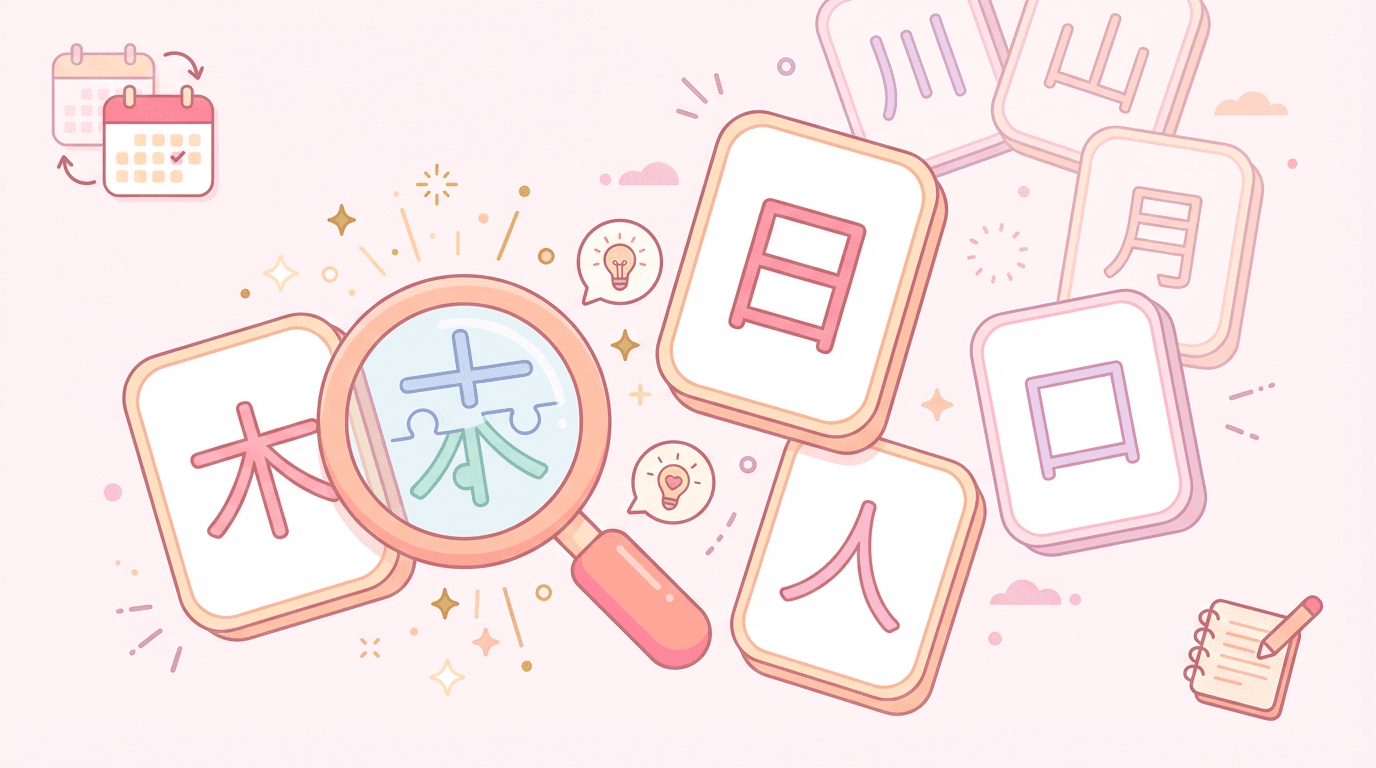
Radicals are the basic components that make up kanji characters. Every single kanji in existence can be broken down into one or more radicals. Some kanji are radicals by themselves (like 木 for "tree"), while others combine multiple radicals into more complex meanings.
Think of radicals as the "alphabet" of kanji. Just as you learned the ABCs before reading English words, learning radicals before tackling full kanji gives you a massive advantage.
The Essential 30 Radicals to Learn First
Here are 30 fundamental radicals that appear constantly in Japanese. Learn these, and you'll start recognizing pieces of kanji everywhere:
Nature & Elements
| Radical | Meaning | Example Kanji | Example Meaning |
|---|---|---|---|
| 日 | sun / day | 明 (bright), 時 (time) | Sun-related concepts |
| 月 | moon / month | 明 (bright), 期 (period) | Time-related concepts |
| 水 / 氵 | water | 海 (sea), 泳 (swim) | Water / liquid |
| 火 / 灬 | fire | 焼 (burn), 煮 (boil) | Heat-related concepts |
| 木 | tree / wood | 森 (forest), 机 (desk) | Wood / plant-related |
| 土 | earth / soil | 地 (ground), 場 (place) | Ground / place |
| 山 | mountain | 岩 (rock), 島 (island) | Landscape |
| 石 | stone | 砂 (sand), 研 (polish) | Stone / hard material |
| 雨 | rain | 雪 (snow), 雲 (cloud) | Weather |
| 金 | metal / gold | 銀 (silver), 鉄 (iron) | Metal / money |
Body & People
| Radical | Meaning | Example Kanji | Example Meaning |
|---|---|---|---|
| 人 / 亻 | person | 休 (rest), 体 (body) | People / human activity |
| 口 | mouth | 食 (eat), 言 (say) | Speaking / eating |
| 目 | eye | 見 (see), 眠 (sleep) | Seeing / perception |
| 手 / 扌 | hand | 持 (hold), 打 (hit) | Actions with hands |
| 足 | foot / leg | 走 (run), 路 (road) | Movement / walking |
| 心 / 忄 | heart / mind | 思 (think), 悲 (sad) | Emotions / thinking |
| 女 | woman | 好 (like), 姉 (older sister) | Female-related |
| 子 | child | 学 (study), 字 (character) | Children / learning |
Structures & Actions
| Radical | Meaning | Example Kanji | Example Meaning |
|---|---|---|---|
| 門 | gate | 開 (open), 間 (between) | Entrances / spaces |
| 言 / 訁 | speech / words | 話 (talk), 読 (read) | Language-related |
| 力 | power / strength | 動 (move), 勉 (effort) | Force / energy |
| 刀 / 刂 | sword / blade | 切 (cut), 分 (divide) | Cutting / dividing |
| 食 / 飠 | eat / food | 飲 (drink), 飯 (rice/meal) | Food-related |
| 糸 / 糹 | thread | 紙 (paper), 線 (line) | Fabric / thin things |
| 車 | vehicle | 転 (roll), 輪 (wheel) | Transportation |
| 貝 | shell (money) | 買 (buy), 貸 (lend) | Commerce / value |
| 田 | rice field | 男 (man), 町 (town) | Agriculture / land |
| 竹 | bamboo | 笑 (laugh), 箱 (box) | Bamboo products |
| 艹 | grass / plant | 花 (flower), 茶 (tea) | Plants / vegetation |
| 宀 | roof / house | 家 (house), 室 (room) | Buildings / shelter |
How to Use Radicals to "Read" New Kanji
Once you know these radicals, something magical happens. You start being able to decode kanji you've never seen before. Here's how:
Step 1: Break it down. When you see an unfamiliar kanji, identify the radicals inside it.
Step 2: Guess the meaning. The radicals often hint at the kanji's meaning category.
Let's try it:
- 清 → 氵(water) + 青 (blue/green) = something related to water that's clear → clean / pure ✓
- 話 → 言 (speech) + 舌 (tongue) = using your tongue to speak → talk / story ✓
- 岩 → 山 (mountain) + 石 (stone) = stone on a mountain → rock / cliff ✓
- 鳴 → 口 (mouth) + 鳥 (bird) = a bird using its mouth → to chirp / to cry out ✓
This doesn't work 100% of the time, but it works often enough to be incredibly useful. Even when your guess isn't perfect, the radical breakdown helps you remember the kanji once you learn the actual meaning.
Mnemonic Strategies: Turn Kanji Into Stories
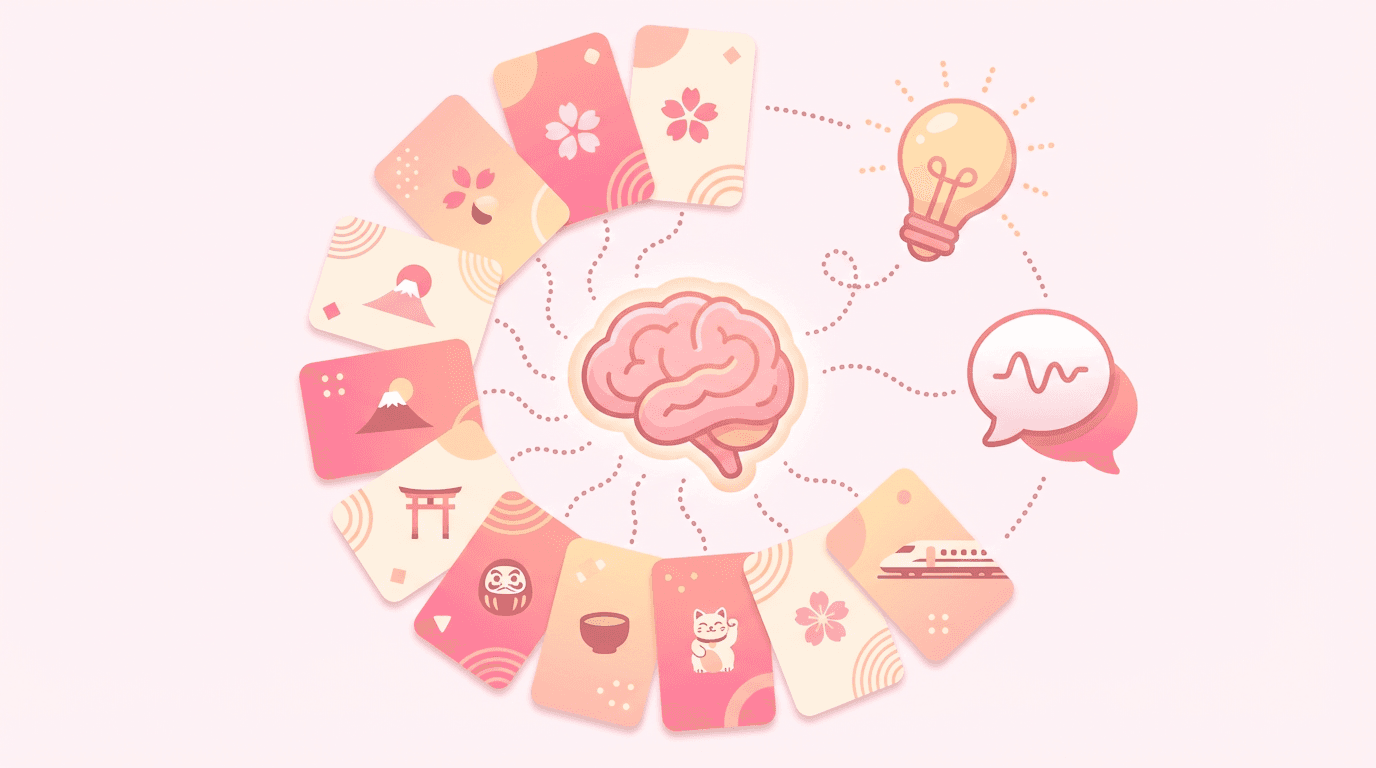
Your brain didn't evolve to memorize abstract symbols. It evolved to remember stories, images, and emotions. Mnemonic techniques exploit this by turning each kanji into a mini-story that's easy to recall.
The Story Method
Take the radicals in a kanji and weave them into a vivid, memorable (often silly) story.
休 (yasumu) — to rest
- Components: 亻(person) + 木 (tree)
- Story: "A person leans against a tree to rest after a long hike."
- Why it works: The image is natural and easy to visualize.
森 (mori) — forest
- Components: 木 (tree) + 木 (tree) + 木 (tree)
- Story: "One tree is just a tree. Two trees is a grove. But THREE trees? That's a forest."
- Why it works: The visual pattern directly maps to the meaning.
好 (suki) — to like / good
- Components: 女 (woman) + 子 (child)
- Story: "A woman holding her child — that feeling of love is what 'like/good' feels like."
- Why it works: It connects to a universal emotional experience.
明 (akarui) — bright
- Components: 日 (sun) + 月 (moon)
- Story: "When both the sun AND the moon are in the sky, everything is super bright."
- Why it works: The logic is almost literal.
男 (otoko) — man
- Components: 田 (rice field) + 力 (power/strength)
- Story: "Who uses strength to work the rice field? The man of the household."
- Why it works: It reflects the historical context of kanji creation.
The Visual Association Method
Instead of a story, create a visual image that links the kanji's shape to its meaning.
- 山 (yama) — mountain: The character literally looks like three mountain peaks. See it?
- 川 (kawa) — river: Three flowing vertical lines, like streams of water flowing down.
- 門 (mon) — gate: It looks like a traditional Japanese gate viewed from the front.
- 雨 (ame) — rain: The top part is a cloud, and the dots below are raindrops falling.
- 木 (ki) — tree: A trunk in the center with branches spreading out at the top and roots below.
Pro Tips for Better Mnemonics
- Make them personal. A story about your own life is more memorable than a generic one.
- Make them absurd. The weirder the image, the better it sticks. A person sleeping on a tree while being attacked by birds? You'll never forget it.
- Make them emotional. Funny, scary, romantic — emotion strengthens memory.
- Create your own. Other people's mnemonics are a good starting point, but yours will always be more memorable to you.
- Say them out loud. Verbalizing the story activates additional memory pathways.
Frequency-Based Learning Order: Start Where It Matters
One of the biggest mistakes kanji learners make is trying to learn kanji in the order they appear in a textbook without considering how useful each character actually is. Instead, prioritize by frequency.
The JLPT Roadmap
The Japanese Language Proficiency Test (JLPT) provides a natural learning progression:
| Level | Kanji Count | Cumulative | Real-World Coverage |
|---|---|---|---|
| N5 | ~80 | 80 | Basic signs, simple sentences |
| N4 | ~170 | 250 | Simple articles, children's books |
| N3 | ~370 | 620 | Newspaper headlines, most daily text |
| N2 | ~380 | 1,000 | News articles, business documents |
| N1 | ~1,000+ | 2,000+ | Literature, specialized texts |
Your First 100 Kanji
Here are some of the highest-frequency kanji you should learn first. Notice how many of them are also radicals — double value!
Numbers & Time: 一 二 三 四 五 六 七 八 九 十 百 千 万 年 月 日 時 分 半 今
People & Body: 人 子 女 男 目 口 手 足 体 力
Nature: 山 川 水 火 木 花 雨 天 空 海
Actions: 見 食 飲 行 来 出 入 書 読 話 聞 思 言 知 学
Adjectives: 大 小 高 長 新 古 多 少 白 赤
Places: 国 学 校 駅 店 家 町 道
These characters appear constantly in everyday Japanese. Master them, and you'll start recognizing words on signs, menus, and websites. That feeling of "I can read that!" is incredibly motivating and will fuel your continued learning.
The 5-3-1 Daily Method
A sustainable pace for kanji learning:
- 5 new kanji per day (25 per week, ~100 per month)
- 3 reviews of yesterday's kanji
- 1 weekly review session for all kanji learned that week
At this pace, you'll reach N5 level in about a month, N4 in three months, and N3 in six months. That's a realistic, achievable timeline — no Chinese background required.
Stroke Order as a Memory Aid
"Do I really need to learn stroke order?" This is one of the most common questions from kanji beginners. The short answer is: yes, and it'll actually make your life easier.
Here's why stroke order isn't just about writing neatly — it's a memory tool.
Stroke Order Creates Muscle Memory
When you write a kanji in the correct stroke order, your hand develops muscle memory for that character. This means your body remembers the kanji even when your mind blanks. It's the same principle as learning to type — you don't think about where each letter is; your fingers just know.
Stroke Order Is Predictable
The good news is that stroke order follows consistent rules:
- Top to bottom (上から下へ): Write upper parts first
- Left to right (左から右へ): Write left parts first
- Horizontal before vertical: When strokes cross, horizontal goes first
- Outside before inside: Write the frame before filling it in
- Close the box last: The bottom stroke of an enclosure comes last
Once you internalize these five rules, you can correctly guess the stroke order of most kanji — even ones you've never written before.
Writing by Hand Boosts Retention
Research in cognitive science supports this. A 2021 study from the University of Tokyo found that students who practiced writing kanji by hand retained 25-30% more characters after one month compared to those who only used digital flashcards. The physical act of writing engages multiple brain areas simultaneously — visual, motor, and spatial — creating stronger memory traces.
You don't need to write every kanji hundreds of times. Even writing each new kanji 5-10 times while saying the reading out loud makes a measurable difference.
Language-Specific Advantages
Here's something encouraging: no matter what your native language is, you probably have some advantage you don't know about. Let's look at what different language backgrounds bring to the table.
Korean Speakers (한국어 화자)
Your hidden advantage: Hanja vocabulary (한자어)
You might think: "I speak Korean, not Chinese. Kanji means nothing to me." But actually, an estimated 60-70% of Korean vocabulary comes from Chinese characters (한자 / hanja). You already use these words every day — you just write them in Hangul instead of kanji.
Here are some examples:
| Korean (한자어) | Japanese Kanji | Meaning |
|---|---|---|
| 학생 (學生) | 学生 (gakusei) | student |
| 도서관 (圖書館) | 図書館 (toshokan) | library |
| 약속 (約束) | 約束 (yakusoku) | promise |
| 가족 (家族) | 家族 (kazoku) | family |
| 시간 (時間) | 時間 (jikan) | time |
The readings are different, but the meanings are identical. Once you learn the kanji forms, you'll discover you already know what hundreds of compound words mean. Your Korean vocabulary is a massive, untapped asset.
Strategy for Korean speakers:
- Start with Sino-Korean vocabulary (한자어) you already know
- Learn the Japanese readings (on'yomi) — they often sound similar to Korean
- Map Korean → Kanji → Japanese readings
Vietnamese Speakers (Người nói tiếng Việt)
Your hidden advantage: Hán-Việt readings (âm Hán Việt)
Vietnamese has a treasure trove of Chinese-derived vocabulary called Hán Việt (漢越). These words entered Vietnamese through centuries of Chinese cultural influence and are used extensively in formal, academic, and official language.
| Vietnamese (Hán Việt) | Japanese Kanji | Meaning |
|---|---|---|
| học sinh (學生) | 学生 (gakusei) | student |
| gia đình (家庭) | 家庭 (katei) | family/household |
| đại học (大學) | 大学 (daigaku) | university |
| tự nhiên (自然) | 自然 (shizen) | nature |
| văn hóa (文化) | 文化 (bunka) | culture |
Like Korean, the readings differ, but the character-meaning pairs are the same. If you know that "học" relates to learning, then you already know the meaning of 学 — you just need to learn the Japanese pronunciation.
Strategy for Vietnamese speakers:
- Make a list of Hán Việt words you use regularly
- Find their kanji equivalents
- Use the meaning connection to anchor your memory
- Focus on learning the Japanese readings as the "new" part
Indonesian / Malay Speakers (Penutur bahasa Indonesia / Melayu)
Your situation: No direct character connection, but strong structural advantages
Indonesian doesn't have a Chinese character heritage in the way Korean or Vietnamese does. However, you have other advantages:
- Familiar with borrowed vocabulary: Indonesian borrows heavily from Sanskrit, Arabic, Dutch, and English. You're already experienced at absorbing vocabulary from completely different language families.
- Simple phonology match: Indonesian and Japanese share similar vowel systems (a, i, u, e, o), making Japanese pronunciation easier for you than for many European language speakers.
- No alphabet confusion: Since you won't be tempted to "match" kanji to a similar system, you'll learn each character on its own terms — which often leads to deeper understanding.
Strategy for Indonesian speakers:
- Use the radical approach fully — it's your primary tool
- Leverage your phonological advantage for readings
- Create mnemonics in Indonesian for better retention
- Don't be discouraged by the lack of cognates — your learning curve just has a different shape
Spanish Speakers (Hablantes de español)
Your hidden advantage: You already know how to learn "root systems"
As a Spanish speaker, you learned Latin and Greek roots as part of understanding your own language. Words like "telefonía" (tele = far, fonía = sound) or "biología" (bio = life, logía = study) follow the exact same logic as kanji compounds.
| Latin/Greek Root Logic | Kanji Compound Logic |
|---|---|
| tele (far) + visión (sight) = televisión | 電 (electric) + 話 (talk) = 電話 (telephone) |
| bio (life) + logía (study) = biología | 生 (life) + 物 (thing) + 学 (study) = 生物学 (biology) |
| auto (self) + móvil (moving) = automóvil | 自 (self) + 動 (move) + 車 (vehicle) = 自動車 (automobile) |
See? You already understand compositional meaning. Kanji radicals are Japan's version of Latin roots.
Strategy for Spanish speakers:
- Think of radicals as "Latin roots for Japanese"
- When learning kanji compounds, break them down the way you break down Spanish words
- Use cognates where they exist (many scientific/technical terms)
- Your strong phonological system will help with pronunciation
Common Mistakes in Kanji Learning
Knowing what NOT to do is just as important as knowing what to do. Here are the most common mistakes that slow learners down:
Mistake 1: Trying to Learn Kanji in Isolation
The problem: Memorizing kanji as individual characters without learning them in words.
Why it fails: Kanji don't exist in isolation in real Japanese. The kanji 生 has over 10 different readings depending on the word it's in. Learning it alone is almost meaningless.
The fix: Always learn kanji within vocabulary words. Learn 学生 (gakusei — student) as a unit, not 学 and 生 separately.
Mistake 2: Rote Repetition Without Understanding
The problem: Writing each kanji 50 times in a row, hoping it sticks.
Why it fails: Mindless repetition creates short-term memory at best. Your brain needs meaning and connection to form long-term memories.
The fix: Use the radical + mnemonic approach. Write each kanji 5-10 times while thinking about the story, then review with spaced repetition.
Mistake 3: Learning Too Many Kanji at Once
The problem: Studying 20-30 new kanji per day in a burst of motivation.
Why it fails: You'll forget 80% of them within a week. Learning without review is like filling a bucket with holes.
The fix: Stick to 3-5 new kanji per day with consistent review. Slow and steady actually IS faster in the long run.
Mistake 4: Skipping Stroke Order
The problem: Writing kanji however "feels right" without following stroke order.
Why it fails: You miss out on the muscle memory benefit, and your handwriting becomes harder for others (and yourself) to read.
The fix: Learn stroke order for at least your first 200-300 kanji. The patterns become automatic after that.
Mistake 5: Comparing Yourself to Chinese Speakers
The problem: Feeling discouraged because Chinese-speaking classmates seem to learn kanji effortlessly.
Why it fails: It leads to frustration and quitting. Chinese speakers have a recognition advantage, but they also face unique challenges (like unlearning simplified Chinese forms or different meanings).
The fix: Focus on your own progress. Your systematic approach builds a deeper, more flexible understanding. By intermediate level, the gap narrows significantly.
Tips for Speakers of Other Languages
No matter what language you speak, here are universal strategies that work:
For Speakers of Languages with Non-Latin Scripts (Arabic, Hindi, Thai, etc.)
You have a unique advantage: you already know what it's like to learn a completely different writing system. You've done this before. The mental flexibility you developed learning your own script will serve you well with kanji. Trust the process — it works the same way.
For English Speakers
English has absorbed words from dozens of languages, so you're already comfortable with "foreign" vocabulary. Use this to your advantage — many Japanese words borrowed from English (外来語 / gairaigo) are written in katakana, not kanji. Learn these easy wins first to build confidence, then tackle kanji.
For Speakers of Tonal Languages (Thai, Mandarin, Cantonese, etc.)
While tonal language experience helps with Japanese pitch accent, the real kanji advantage depends on whether your language uses Chinese characters. Thai speakers, for instance, have pitch sensitivity but no character knowledge — use the radical approach and your audio learning strengths together.
Universal Tips
- Label your environment. Put sticky notes with kanji on objects around your house. Constant passive exposure adds up.
- Read real Japanese early. Even if you only recognize 10% of the kanji, the context helps. Try NHK News Easy or children's manga.
- Use kanji in sentences. Write a daily journal entry using the kanji you've learned. Active use beats passive review.
- Find a study buddy. Especially someone with a different native language — you can share unique mnemonic perspectives.
- Track your progress. Keep a kanji log. Seeing "I knew 0 kanji in January, and now I know 150" is incredibly motivating.
Real Learner Insights
Here's what real learners from different backgrounds have shared about their kanji learning journeys:
"The radicals changed everything." — Maria, Spanish speaker, living in Tokyo
"I spent my first six months just drilling kanji from a textbook. I'd memorize them, forget them, re-memorize them, forget them again. Then I discovered the radical approach. Within two weeks, I went from recognizing maybe 100 kanji to being able to break down almost any character I saw. I still didn't know the reading, but I could guess the meaning category. That was the turning point for me."
"Korean helped more than I expected." — Jiwon, Korean speaker, studying for JLPT N2
"I always thought Korean and Japanese were completely different because of the writing systems. But when I started mapping 한자어 to kanji, I realized I already 'knew' hundreds of kanji meanings. The word 도서관 has the same characters as 図書館. My Korean vocabulary became my kanji cheat code. I went from N4 to N2 in just one year."
"Mnemonics made it fun instead of painful." — Dimas, Indonesian speaker, self-studying in Jakarta
"I have no Chinese or Korean background, so I thought I was at a massive disadvantage. But honestly, the mnemonic method works so well that I don't feel disadvantaged at all. I make up little stories in Indonesian for every kanji I learn. 森 (forest) = three trees stacked together? That's just common sense! I learn about 5 kanji a day and I'm at around 600 now. No Chinese needed."
"Writing by hand was the key I was missing." — Nguyen, Vietnamese speaker, university student
"I tried app-only learning for a year and could recognize kanji in context, but I kept mixing up similar-looking ones. When I started writing by hand — just 10 minutes a day — the confusion disappeared. My hand remembers what my eyes forget. Plus, I found out that so many Vietnamese words come from the same Chinese characters. Học = 学, sinh = 生, so học sinh = 学生. Mind blown."
FAQ
Q: How many kanji do I actually need to learn?
A: It depends on your goals. For basic daily life in Japan, 300-500 kanji (JLPT N4-N3 level) will get you through most situations — reading menus, signs, basic emails, and simple articles. For professional or academic use, aim for 1,000-2,000 (N2-N1 level). For casual reading of manga and social media, about 800 is a comfortable starting point. Don't think of it as "all 2,136 or nothing." Every kanji you learn opens new doors.
Q: How many kanji should I learn per day?
A: For most learners, 3-5 new kanji per day is the sweet spot. This pace is sustainable long-term and allows enough time for review. At 5 per day, you'll learn about 150 per month — reaching N5 level in your first month and N4 within three months. Some learners can handle 10 per day, but only with a strict review schedule. Going above 10 consistently leads to burnout and poor retention.
Q: Is it possible to learn kanji without writing by hand?
A: Yes, it's possible — many learners use only digital tools and flashcards. However, research and learner experience consistently show that handwriting significantly improves retention. You don't need to become a calligraphy master. Even writing each new kanji 5-10 times when you first learn it makes a noticeable difference. Think of handwriting as an optional but highly recommended booster, not a strict requirement.
Q: Should I learn on'yomi (Chinese readings) or kun'yomi (Japanese readings) first?
A: Learn them in context, not in isolation. When you learn a kanji through a vocabulary word, you naturally learn the relevant reading. For example, learn 山 as やま (yama — mountain, kun'yomi) from the word 山 by itself, and as サン (san — on'yomi) from 富士山 (Fujisan — Mount Fuji). Trying to memorize all readings before learning words is inefficient and frustrating. Let vocabulary guide your reading acquisition.
Q: I keep forgetting kanji I've already learned. What am I doing wrong?
A: Nothing — forgetting is a normal part of learning. The key is using a spaced repetition system (SRS) like Anki, WaniKani, or even simple flashcards with a review schedule. SRS is designed around the science of forgetting: it shows you a kanji just before you're about to forget it, which strengthens the memory each time. If you're forgetting quickly, you might also be learning too many new kanji without enough review. Try reducing new kanji to 2-3 per day and increasing review time.
Example Sentences
Here are practical sentences using common kanji, organized from simple to intermediate:
| Japanese | Romaji | English |
|---|---|---|
| 山が見えます。 | Yama ga miemasu. | I can see the mountain. |
| 水を飲みたいです。 | Mizu wo nomitai desu. | I want to drink water. |
| この本は面白いです。 | Kono hon wa omoshiroi desu. | This book is interesting. |
| 毎日、漢字を五つ覚えます。 | Mainichi, kanji wo itsutsu oboemasu. | I memorize five kanji every day. |
| 日本語の勉強は楽しいです。 | Nihongo no benkyou wa tanoshii desu. | Studying Japanese is fun. |
| 電車で学校に行きます。 | Densha de gakkou ni ikimasu. | I go to school by train. |
| 休みの日に図書館で本を読みます。 | Yasumi no hi ni toshokan de hon wo yomimasu. | On my days off, I read books at the library. |
| 漢字の部首を覚えると、新しい漢字が分かりやすくなります。 | Kanji no bushu wo oboeru to, atarashii kanji ga wakariyasuku narimasu. | When you learn kanji radicals, new kanji become easier to understand. |
| 毎日少しずつ練習すれば、必ず上手になります。 | Mainichi sukoshi zutsu renshuu sureba, kanarazu jouzu ni narimasu. | If you practice a little every day, you will definitely improve. |
| 中国語を知らなくても、漢字は覚えられます。 | Chuugokugo wo shiranakutemo, kanji wa oboeraremasu. | Even without knowing Chinese, you can learn kanji. |
Conclusion
Let's circle back to where we started. You don't speak Chinese, and you're worried that kanji will be impossible for you. Here's what we've established:
- Kanji is not 2,000+ random symbols. It's combinations of ~214 radicals that follow logical patterns.
- The radical approach gives you a framework to decode, understand, and remember kanji — no Chinese knowledge required.
- Mnemonics turn abstract characters into memorable stories your brain actually wants to remember.
- Frequency-based learning means you can start reading real Japanese with just 100-200 kanji.
- Your native language — whether Korean, Vietnamese, Indonesian, Spanish, or anything else — gives you advantages you might not have discovered yet.
- Consistent daily practice (3-5 kanji/day + review) beats cramming every time.
The learners who succeed with kanji aren't the ones with the "right" language background. They're the ones who show up every day, use smart strategies, and don't give up when it gets hard.
You have everything you need to start. The only question is: which radical are you going to learn first?