Introduction
So you've decided to take the JLPT N5 — great choice! Whether you're a few weeks into learning Japanese or you've been studying on your own for a while, the JLPT N5 is the perfect first milestone to aim for.
But where do you actually start? What vocabulary do you need? How much grammar? And what does the test even look like?
In this guide, we'll walk through everything you need to know to pass the JLPT N5 — from the test structure to a practical study plan you can follow from day one.
Quick Answer
Quick Answer: JLPT N5 tests basic Japanese ability, covering around 800 vocabulary words, 100 kanji, and 72 grammar patterns. With 3–6 months of consistent daily study, most beginners can pass by focusing on hiragana, katakana, basic vocabulary, and foundational grammar.
What is the JLPT N5?
The JLPT (Japanese Language Proficiency Test) is the world's most recognized Japanese certification, administered twice a year (July and December) in over 80 countries.
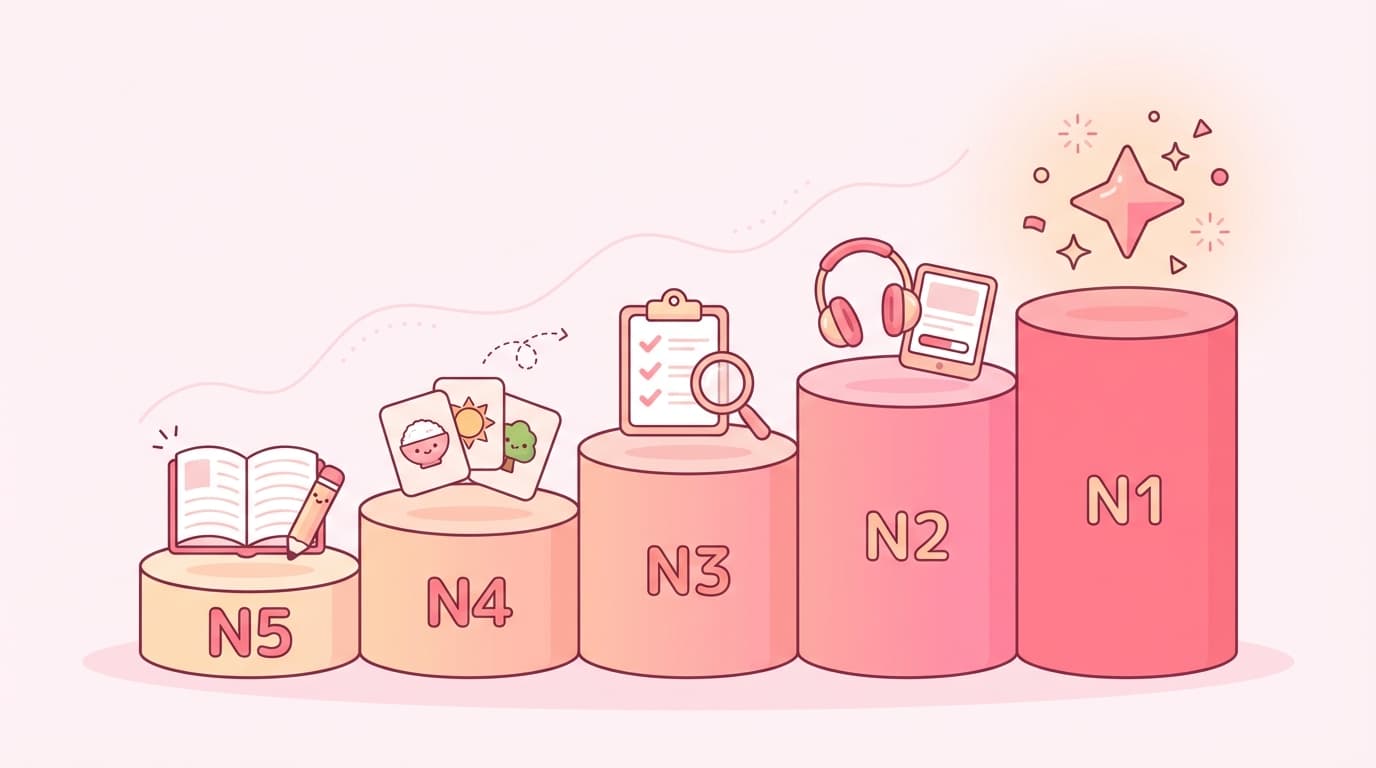
N5 is the lowest level, making it the ideal starting point for beginners. Passing N5 proves you understand basic Japanese — including simple conversations, everyday vocabulary, and fundamental grammar structures.
Here's how the test is structured:
| Section | Time | Points |
|---|---|---|
| Language Knowledge (Vocabulary) | 25 min | 60 pts |
| Language Knowledge (Grammar) + Reading | 50 min | 60 pts |
| Listening | 30 min | 60 pts |
| Total | 105 min | 180 pts |
Passing score: You need at least 80 points total, with a minimum score in each section. You can't ace one section and fail another — balance matters.
JLPT N5 Vocabulary and Kanji
Here's what you're working with at N5 level:
- Vocabulary: ~800 words
- Kanji: 100 characters
- Focus areas: Numbers, time, family, food, daily actions, greetings, basic adjectives
The vocabulary is very practical — things you'd actually use in real life conversations. Words like 食べる (taberu — to eat), 電車 (densha — train), and 学校 (gakkou — school) are typical N5 vocabulary.
For kanji, you'll cover basics like 日, 月, 山, 川, 人, 大, 小, and numbers 1–10. These 100 kanji are the foundation everything else builds on, so learn them well.
If you want a structured list of all 800 vocabulary words and 100 kanji organized by topic, our JLPT N5 Study Workbook covers them all in one place.
JLPT N5 Grammar: The 72 Patterns You Need
N5 grammar covers 72 fundamental patterns that form the backbone of Japanese sentences. Here are the key categories:
Particles (助詞):
- は (topic marker), が (subject marker), を (object), に (location/direction), で (location of action), から (from), まで (until)
Verb forms:
- ます/ません (polite present/negative)
- ました/ませんでした (polite past)
- て-form (connecting actions, making requests: ~てください)
- たい (want to do something)
Adjectives:
- い-adjectives and な-adjectives in present and past tense
Basic structures:
- Noun + です/じゃありません
- ~がありますいます (there is/are)
- ~にいきます/きます (going/coming to a place)
Mastering these patterns is more important than memorizing every rule. Practice using them in sentences — not just recognizing them.
Your 3-Month JLPT N5 Study Plan
Here's a realistic study plan that works even if you're studying part-time (about 1 hour per day):
Month 1: Build Your Foundation
- Master hiragana and katakana (aim for 2 weeks)
- Learn 10–15 new vocabulary words per day
- Study basic sentence structure (Noun + です, basic particles)
- Start with kanji numbers and common radicals
Month 2: Expand Grammar and Vocabulary
- Work through all N5 grammar patterns systematically
- Continue vocabulary: target 400+ words learned by end of month
- Practice reading simple sentences and short texts
- Begin listening practice: NHK Web Easy, beginner podcasts
Month 3: Test Preparation
- Take full practice tests under timed conditions
- Review weak areas identified in practice tests
- Focus on listening (it trips up many test-takers)
- Aim for 80%+ accuracy on practice tests before the real exam
Our YouTube JLPT lessons cover many N5 grammar points with real-world examples and practice exercises to help you internalize each pattern.
Example Sentences
| Japanese | Romaji | English |
|---|---|---|
| 私は学生です。 | Watashi wa gakusei desu. | I am a student. |
| 電車で学校に行きます。 | Densha de gakkou ni ikimasu. | I go to school by train. |
| 今日は寒いですね。 | Kyou wa samui desu ne. | It's cold today, isn't it? |
| 水をください。 | Mizu wo kudasai. | Please give me water. |
| 猫が好きです。 | Neko ga suki desu. | I like cats. |
| 昨日、映画を見ました。 | Kinou, eiga wo mimashita. | Yesterday, I watched a movie. |
Common Mistakes
1. Skipping hiragana and katakana Don't move on until you can read both scripts fluently. They take about 2 weeks to learn, and everything else depends on them. You won't have time to look up characters during the test.
2. Memorizing vocabulary without context Flashcard apps are useful, but you'll retain words much better when you see them in sentences. Learn vocabulary in phrases, not in isolation.
3. Ignoring listening practice until the last minute The listening section catches many people off guard. Start listening to Japanese from month one — even if you don't understand much yet. Your brain needs time to get used to the sounds and rhythm.
4. Cramming the night before The JLPT tests long-term retention, not short-term recall. Consistent daily study over months beats intense last-minute cramming every time.
5. Confusing particles は vs. が, に vs. で — these are classic stumbling blocks. Don't just memorize rules; practice each particle with lots of example sentences until it feels natural.
Tips for Speakers of Other Languages
Learning JLPT N5 can feel different depending on your native language. Here are specific tips:
For Korean speakers (한국어 화자) Korean and Japanese share nearly identical sentence structure (SOV) and a particle system that maps closely to each other. N5 grammar will feel intuitive from the start — but don't skip hiragana and katakana practice just because grammar clicks quickly. Your writing foundation still needs deliberate work.
For Chinese speakers (中文母语者) Your kanji knowledge is a huge head start for vocabulary and kanji recognition. However, watch out for false friends — words like 手紙 (letter in Japanese, toilet paper in Chinese) and 勉強 (study in Japanese, reluctant in Chinese) can catch you off guard. Focus extra time on learning hiragana and katakana, which have no equivalent in Chinese.
For Vietnamese speakers (Người nói tiếng Việt) Vietnamese and Japanese share some similar vowel sounds, which can make Japanese pronunciation easier to pick up than for European language speakers. Grammar structure requires fresh learning since Vietnamese is an analytic language without the particle system. Focus on building the habit of placing verbs at the end of sentences.
For Spanish speakers (Hablantes de español) Spanish vowels (a, e, i, o, u) are pronounced similarly to Japanese vowels, giving you a natural head start with hiragana reading. However, Japanese sentence structure is the opposite of Spanish (verb at the end, not in the middle). Take time to internalize this flip — it affects everything from particle usage to how you process listening.
For Indonesian speakers (Penutur bahasa Indonesia) Indonesian and Japanese both lack grammatical gender and complex tense systems, so the concept of expressing time through context (rather than strict verb forms) will feel familiar. Indonesian has borrowed many Dutch and English words written in katakana form — this gives you a quick entry point for building katakana vocabulary through loanwords.
Practice Tips
1. Use spaced repetition for vocabulary Apps like Anki let you review vocabulary at optimal intervals, so you remember words long-term without over-reviewing easy ones.
2. Practice reading hiragana and katakana daily Even after you "know" them, keep reading Japanese text every day to build speed. Slow reading drains time during the test.
3. Do timed practice tests Time pressure is real. Practice completing each section within the time limit — not just getting the right answers.
4. Listen actively, not just passively When listening to Japanese audio, engage actively: try to predict what comes next, replay unclear parts, and shadow (repeat) what you hear.
5. Write Japanese by hand Writing kanji by hand (not just typing) helps you remember stroke order and fine details that are tested on the exam.
Real Learner Insights
Based on common patterns we see among Japanese learners:
- The "aha" moment: Many JLPT N5 learners describe a breakthrough when they first read a real Japanese sentence — a menu item, train sign, or text message — and understand it without looking anything up. That moment of "I actually read that!" makes all the flashcard grinding feel worthwhile.
- Common confusion point: The は vs. が distinction trips up almost every N5 learner at some point. It's not a grammar rule you can memorize — it's a feel you develop over time through reading many example sentences. Most learners only truly "get it" after seeing dozens of examples in context.
- What works: Consistent 30-minute daily sessions consistently beat longer but infrequent study blocks. Many successful N5 passers study during commutes or lunch breaks rather than waiting for a "proper study session."
Frequently Asked Questions
Q: How long does it take to pass JLPT N5? Most learners need 3–6 months of consistent daily study (1 hour/day) to pass. If you're studying more intensively (2–3 hours/day), 6–8 weeks is achievable.
Q: Is JLPT N5 hard? Compared to higher levels, N5 is manageable — but don't underestimate it. The vocabulary and kanji list is extensive, and the listening section is genuinely challenging for beginners. Start early and practice consistently.
Q: Can I pass JLPT N5 by self-studying? Absolutely. Many N5 passers are self-taught. With structured workbooks, vocabulary tools, and practice tests, you don't need a formal class to pass N5.
Q: What happens if I fail one section? In the JLPT, each section has a minimum passing score. If you score below the minimum in any one section — even if your total score is high enough — you'll fail the test. This is why balanced study matters.
Q: What should I study first: vocabulary or grammar? Start with the scripts (hiragana + katakana), then learn vocabulary and grammar together. Many grammar patterns only make sense once you have some vocabulary to work with, and vocab becomes easier to remember when you know basic grammar structures.
Q: Is JLPT N5 easier for Korean speakers? Yes, significantly. Korean and Japanese share the same sentence structure, a parallel particle system, and thousands of Chinese-origin vocabulary words. Korean speakers often reach N5 readiness in 2–3 months compared to 3–6 months for English speakers. Grammar clicks intuitively, though writing systems still require dedicated practice.
Q: Can Chinese speakers skip some N5 study because of kanji knowledge? Chinese speakers can skip much of the kanji meaning study since many characters overlap. However, the readings (on'yomi and kun'yomi) must be learned from scratch, and hiragana/katakana are entirely new. Chinese speakers often spend 40–50% less time on vocabulary but the same time on grammar and listening as other learners.
Q: I speak Spanish — is N5 listening particularly hard for me? Spanish speakers generally find Japanese vowels easy to hear clearly, since both languages share clean, consistent vowel sounds. The challenge tends to be speed and the unfamiliar rhythm of agglutinative verb endings. Starting listening practice early and shadowing native audio will smooth this out within a few weeks.
Related Resources
- JLPT N5 Study Workbook — PDF Download
- Watch: JLPT N5 Lessons on YouTube
- Browse all Japanese study materials