Introduction
If you've spent more than five minutes researching Japanese study goals, you've probably come across the acronym JLPT. It shows up in job requirements, university admissions, and almost every "how to prove your Japanese" conversation online.
But what exactly is the JLPT? How does it work? And which level should you actually aim for?
This guide answers all of that from scratch — no prior knowledge required.
Quick Answer
Quick Answer: The JLPT (Japanese Language Proficiency Test) is an internationally recognized certification exam that measures Japanese reading and listening ability across five levels, from N5 (beginner) to N1 (advanced). It does not test speaking or writing.
What Is the JLPT?
JLPT stands for Japanese Language Proficiency Test (日本語能力試験 — Nihongo Nōryoku Shiken). It's administered by the Japan Foundation and Japan Educational Exchanges and Services (JEES).
The test is offered twice a year in Japan (July and December), and once a year in many overseas locations (typically December). It's taken in over 80 countries worldwide.
The JLPT is widely recognized by:
- Japanese employers as proof of professional language ability
- Universities in Japan for admissions and exemptions
- Immigration authorities for certain visa categories
- Language learning communities as a benchmark for progress
One important thing to know upfront: the JLPT does not test speaking or writing. It's entirely multiple-choice. You'll be tested on vocabulary, grammar, reading comprehension, and listening.
The 5 JLPT Levels
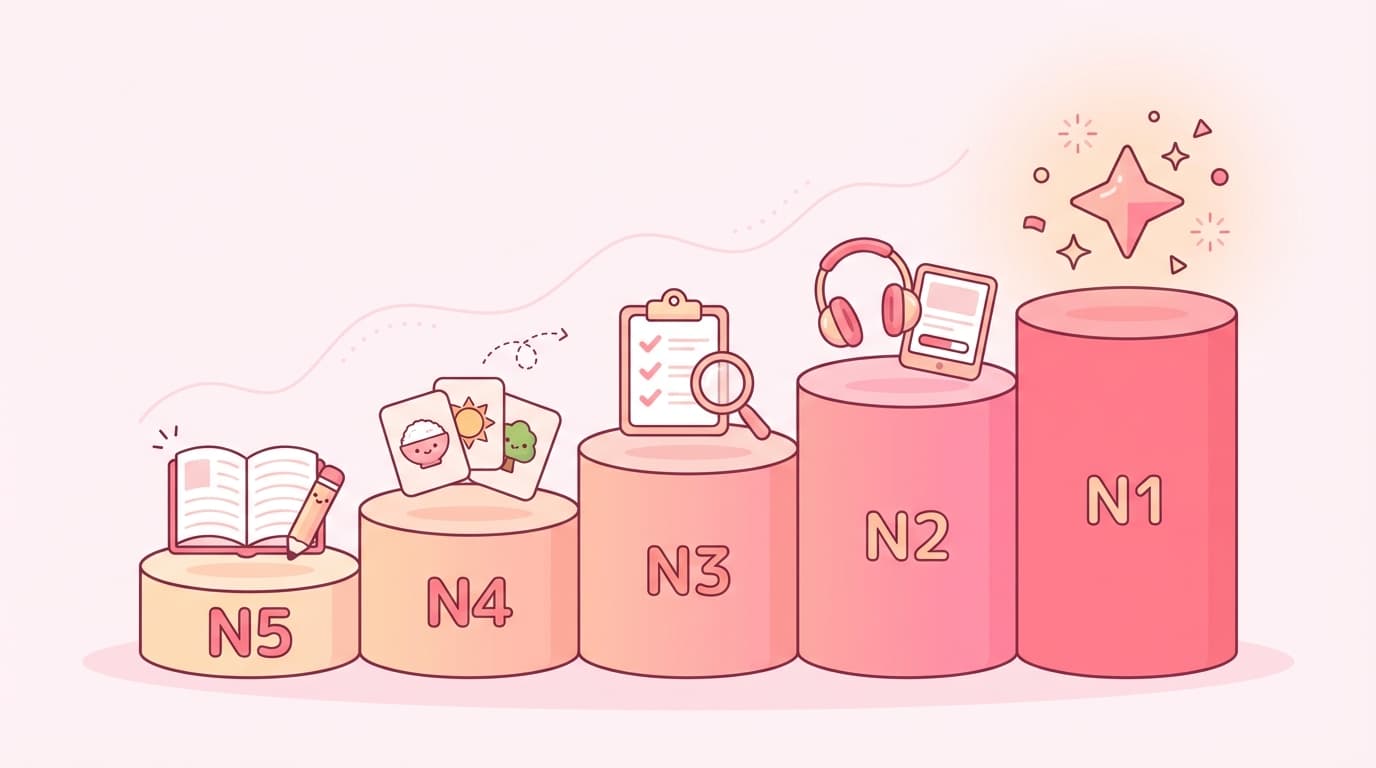
The JLPT has five levels, numbered N1 through N5. N5 is the easiest and N1 is the hardest.
| Level | Official Description | Who It's For |
|---|---|---|
| N5 | Ability to understand some basic Japanese | Total beginners, 3–6 months of study |
| N4 | Ability to understand basic Japanese | Those who finished a beginner textbook |
| N3 | Ability to understand Japanese used in everyday situations to a certain degree | Intermediate learners bridging beginner and advanced |
| N2 | Ability to understand Japanese in everyday situations and a variety of circumstances | Upper-intermediate; close to working level |
| N1 | Ability to understand Japanese used in a variety of circumstances | Near-native fluency; academic and professional use |
N3 sits in the middle and is often called the "gateway" level — it's the first level that many employers and schools consider meaningful proof of practical ability.
Test Format: What's Actually On the Exam
The test structure is slightly different depending on whether you're taking N1–N3 or N4–N5.
N1, N2, and N3 have three separate scoring sections:
- Language Knowledge (Vocabulary/Grammar) — vocabulary, grammar patterns, sentence completion
- Reading — short and long passage comprehension
- Listening — audio questions with answer choices
N4 and N5 combine vocabulary, grammar, and reading into one section:
- Language Knowledge (Vocabulary/Grammar) · Reading — combined section
- Listening — audio questions with answer choices
Total test duration varies by level, ranging from about 105 minutes (N5) to 170 minutes (N1).
How Passing Works: Scores Explained
The JLPT uses a scaled scoring system. Your raw score is converted using statistical methods to ensure fairness across different test administrations.
The most important rule: you need to pass two thresholds simultaneously.
- Total score must meet or exceed the overall passing score
- Each section score must meet or exceed the sectional passing score
Here are the official passing thresholds:
| Level | Total Score | Pass Total | Sectional Minimum |
|---|---|---|---|
| N5 | 180 points | 80/180 | 19/60 per section |
| N4 | 180 points | 90/180 | 19/60 per section |
| N3 | 180 points | 95/180 | 19/60 per section |
| N2 | 180 points | 90/180 | 19/60 or 38/120 per section |
| N1 | 180 points | 100/180 | 19/60 or 38/120 per section |
The sectional minimum is critical. Even if your total score is well above the pass mark, failing a single section automatically means failing the test. Many test-takers are surprised to learn this.
If you want to practice real JLPT-format reading and listening, our JLPT N5 study materials follow the official test structure so you can get familiar with how it all works.
Which Level Should You Start With?
Here's a practical breakdown based on where you are right now:
Start with N5 if:
- You can read hiragana and katakana
- You know around 50–100 basic vocabulary words
- You've been studying Japanese for a few months
Start with N4 if:
- You've finished a beginner textbook (Genki I, Minna no Nihongo I)
- You're comfortable with basic verb conjugations
- You can handle simple everyday conversations in Japanese
Start with N3 if:
- You can read short newspaper headlines
- You've been studying consistently for 1–2 years
- You want a certification that carries weight with employers
If you're unsure, N5 is always a safe first goal. Passing it builds momentum and shows you exactly where your weak points are before attempting higher levels.
Do You Have to Take the Levels in Order?
No. You can register for any level directly — there's no requirement to pass N5 before attempting N4, or N4 before N3. Many learners skip N5 entirely and start at N4 once they have the basics down.
However, each level builds significantly on the one below it, so jumping too many levels at once usually doesn't end well.
Example Sentences by Level
Here's a sense of the reading difficulty at each level:
| Japanese | Romaji | English |
|---|---|---|
| これは本です。 | Kore wa hon desu. | This is a book. (N5 level) |
| 毎朝、電車で会社に行きます。 | Maiasa, densha de kaisha ni ikimasu. | I go to work by train every morning. (N4 level) |
| 昨日の会議では、様々な意見が出た。 | Kinō no kaigi de wa, samazama na iken ga deta. | Various opinions came up in yesterday's meeting. (N3 level) |
| 彼の発言は誤解を招くおそれがある。 | Kare no hatsugen wa gokai wo maneku osore ga aru. | His statement could lead to misunderstandings. (N2 level) |
| その論文は専門家でさえ理解しがたい内容だ。 | Sono ronbun wa senmonka de sae rikai shigatai naiyō da. | That paper contains content that even specialists find difficult to understand. (N1 level) |
Common Mistakes
1. Focusing only on total score Because of the sectional minimum rule, test-takers who practice only their strong areas often fail a weak section. Balance your preparation across all sections.
2. Ignoring the listening section Many learners spend most time on grammar and vocabulary but underestimate listening. In N3–N1, the listening section is 60 out of 180 points — too significant to skip.
3. Registering for a level that's too high The JLPT measures what you can do now, not what you're aiming for. Registering for N2 when you're N4-level doesn't speed up your progress — it just leads to a discouraging result.
4. Assuming N5 is "too easy to bother with" N5 is a solid milestone. Passing it confirms your fundamentals and gives you a real certificate to put on your resume.
Tips for Speakers of Other Languages
Understanding the JLPT can feel different depending on your native language. Here are specific tips:
For Korean speakers (한국어 화자) Korean speakers typically reach N5 readiness in 2–4 months and can target N4 within 6 months of starting. If you're planning your JLPT timeline, consider registering for N4 directly after 4–5 months of study rather than taking N5 as a stepping stone — many Korean learners find N5 feels within grasp before they're even ready to test. That said, N5 still provides useful practice with the test format itself.
For Chinese speakers (中文母语者) Chinese speakers should pay special attention to the listening section when planning JLPT preparation. Your kanji advantage helps enormously with vocabulary and reading, but listening requires the same daily immersion practice as any other learner. Many Chinese speakers who underestimate listening end up failing a section despite strong reading scores — the sectional minimum rule makes this a real risk.
For Vietnamese speakers (Người nói tiếng Việt) Vietnamese speakers should plan for longer preparation times compared to Korean or Chinese speakers — roughly 4–8 months for N5, 8–14 months for N4. This isn't a disadvantage, it's just a realistic timeline. The JLPT level system rewards consistent, patient study, and Vietnamese speakers who study steadily tend to have strong, durable foundations at each level they pass.
For Spanish speakers (Hablantes de español) JLPT preparation for Spanish speakers benefits from structured grammar study right from the beginning. Spanish speakers are often good at grammatical analysis (from years of studying Spanish grammar), and applying that skill to Japanese grammar patterns — studying them systematically rather than just immersively — accelerates comprehension of how the JLPT tests grammar knowledge.
For Indonesian speakers (Penutur bahasa Indonesia) Indonesian speakers should focus on building reading fluency as a specific preparation goal. The JLPT reading section requires processing Japanese text at speed, which takes consistent daily practice. Starting with NHK Web Easy (simplified Japanese news) at the N4–N3 preparation stage gives Indonesian learners the regular reading exposure that builds both speed and comprehension.
Practice Tips
-
Take one full practice test early — Even six months before the real test, attempt a full-length practice test under timed conditions. This shows you exactly which sections need the most attention.
-
Review official past questions — The Japan Foundation releases sample questions on the JLPT website. These are the most reliable materials available.
-
Build vocabulary systematically — Vocabulary is tested directly (in the Language Knowledge section) and indirectly in reading and listening. Use spaced repetition flashcards to build vocabulary daily.
-
Listen every day, even for 10 minutes — The listening section requires processing audio at natural speed with no rewind. Daily immersion matters more than cramming the week before.
-
Time yourself on reading sections — Many test-takers struggle with time, especially on N3–N1 reading. Practice moving quickly without re-reading every sentence.
Real Learner Insights
Based on common patterns we see among Japanese learners:
- The "aha" moment: Many JLPT first-timers describe taking a practice test and discovering that they score better on listening than they expected — and worse on reading than they expected. The test format reveals surprising gaps that regular study doesn't expose. Taking a full practice test early, even when you feel underprepared, is one of the highest-value actions you can take before the real exam.
- Common confusion point: The sectional minimum rule catches many learners off guard. Learners who focus heavily on grammar and vocabulary sometimes neglect listening, pass the total score threshold, then fail the listening section minimum. Understanding that all three sections must meet their floor — not just the total — changes how you allocate study time.
- What works: Learners who pass their first JLPT attempt tend to be those who registered for a level where they were already at roughly 75–80% accuracy on practice questions at least one month before the test. Registering for a level where you're at 50–60% accuracy and hoping to "catch up" rarely works. Honest self-assessment of readiness before registration makes a concrete difference in first-attempt pass rates.
Frequently Asked Questions
Q: Does the JLPT certificate expire? No, JLPT certificates do not expire. A certificate you earned ten years ago is still valid today.
Q: Is there a speaking or writing section on the JLPT? No. The JLPT is entirely multiple-choice and does not test speaking or writing ability. If you need to demonstrate those skills, you'd need a different certification.
Q: How many times can I take the JLPT in a year? In Japan, the JLPT is offered twice a year: in July and December. In most overseas locations, it's held once a year, typically in December. You can take the same level multiple times.
Q: Which JLPT level is required for working in Japan? Requirements vary by company and role. Many office jobs ask for N2 or above. Some technical or creative fields accept N3. For jobs that require native-level communication, N1 may be expected.
Q: Can I take N3 if I've never taken N5 or N4? Yes. There are no prerequisites — you can register for any level directly. Many intermediate learners skip N5 and N4 entirely and go straight for N3.
Q: How long does it take to prepare for each level? This varies significantly by your native language and daily study time. Korean and Chinese speakers typically progress faster than English speakers due to shared grammar or kanji knowledge. A realistic estimate for consistent daily study (1–2 hours) from zero: N5 in 3–6 months, N4 in 6–12 months, N3 in 12–18 months.
Q: Is the JLPT significantly easier for Korean speakers? At N5 and N4 levels, yes — the structural similarities between Korean and Japanese grammar create a meaningful advantage in the grammar and vocabulary sections. Korean speakers often describe N5 grammar questions as feeling almost self-evident. However, listening requires the same dedicated practice for Korean speakers as for any other learner, and kanji readings (especially kun'yomi) need specific study regardless of Korean background.
Q: How does having a Chinese language background affect JLPT preparation strategy? Chinese speakers should re-allocate preparation time significantly toward listening and grammar compared to a typical learner. Reading and vocabulary preparation can be compressed thanks to kanji knowledge, freeing up time for the sections where the advantage is smaller. The specific risk for Chinese speakers is neglecting listening — many pass the reading section easily but fall below the sectional minimum in listening, which fails the test despite overall strong performance.
Q: What's a realistic JLPT timeline for Vietnamese speakers? Vietnamese speakers should plan for approximately twice the preparation time that Korean speakers need for each level — 4–8 months for N5, 8–15 months for N4, 18–24 months for N3, each with consistent daily study. This is not a disadvantage in terms of outcome — it's just an accurate timeline that prevents frustration. Vietnamese speakers who set realistic expectations tend to study more consistently and pass more reliably than those who underestimate preparation time.
Related Resources
- Watch JLPT N5 YouTube lessons
- JLPT N5 Study Materials — PDF Download
- JLPT N4 Study Materials — PDF Download
- JLPT N3 Study Materials — PDF Download